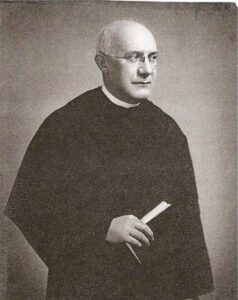
 The thirteen years which Father Aurelio Marini spent as pastor of Buon Consiglio Parish in Philadelphia, came to a difficult end on May 3, 1933, and marked, as well, the controversial closure of Philadelphia’s largest Italian parish. Those actions were due neither to Father Marini’s performance nor choosing, but to the decision of a higher authority, namely that of the Archbishop of Philadelphia. The rationale for the ruling was that the Italian population in the neighborhood of the church had shifted, and a readjustment was in order. A study had been conducted by area pastors with the recommendation that the Italians be served by two other parishes which now would be given Italian pastors. Cardinal Dougherty accepted the recommendation and ordered Buon Consiglio suppressed. The response of the parishioners was immediate and intense.
Buon Consiglio had been founded in 1899 by Italian Augustinian Friars at the request of then Archbishop Patrick Ryan and had been served by the friars ever since. One of the complaints of Buon Consiglio parishioners regarding the decision to close was that the Augustinians would not be given one of the two churches into which the people themselves would now be absorbed. “We want the Augustinians,” was one of their battle cries. But the Cardinal was adamant that the friars would not be given another church. Instead, he raised Buon Consiglio’s mission church of Saint Nicholas of Tolentino to the status of a parish and transferred the official canonical residence of the friars to that community. The protests against the suppression raged on for several years in the form of demonstrations, the temporary closure of local businesses, appeals to Rome and continuous coverage by the local and national press. They ended finally with a decision of the Supreme Court of Pennsylvania against the protestors in April 1936.
The unfortunate closure of a once-thriving parish originally established to accompany an immigrant population in an unfamiliar and sometimes inhospitable environment, did not undo, however, the bonds between the people and the Augustinians. Father Marini, together with two other friars who had been his assistants at Buon Consiglio, moved to the parish of Saint Nicholas of Tolentino some blocks away where a number of Buon Consiglio’s parishioners followed them. Father Marini’s new role there was that of assistant to Saint Nicholas’ newly appointed pastor, Father Claudio Fabrizi, O.S.A. Father Marini would continue on at Saint Nicholas until 1935, when he was re-assigned to Holy Rosary Parish in Lawrence, Massachusetts.
Aurelio Marini had been born on October 22, 1885 in Piancarani, Teramo, Italy, the son of Simone Marini, a tailor, and Maria Faloni. At birth, he was given the name Crispino in honor of his paternal grandfather. Aurelio was the name he received when he entered religious life. At the age of three his mother died, and his father remarried. From this second marriage two sons and three daughters were born. Discerning a vocation to religious life, Crispino entered the Congregation of Discalced Augustinians with whom he professed solemn vows in February 1906. On May 8, 1908, he withdrew from the Discalced Congregation and made a novitiate with the Order of Saint Augustine in Carpineto Romano. He was professed in the Order in 1909 and was ordained to the priesthood on January 1, 1910 in Rome.
On December 8 of that year, Father Marini, accompanied by a confrere, Father Clemente Capozzi, O.S.A., departed Italy for the United States and arrived fourteen days later with the aim of joining the Mission of the Italian Augustinians centered in Philadelphia. His first assignment, however, was to Saint Paul’s Parish in Mechanicville, New York, served by the American Augustinians. Here he was able to acquire fluency in English while serving the Italians of the area. This was followed in July 1911 with his appointment as assistant at the parish of Holy Rosary in Lawrence, which for several years formed part of the Augustinian Italian Mission. Father Marini’s commitment to the Mission and to his adopted country was solidified in April 1917 when he became a naturalized citizen of the United States.
In January 1920, the Prior Provincial of the American Province, Father Nicholas Vasey, O.S.A., who was also the Prior General’s appointed superior of the Italian Mission, proposed 35-year-old Father Marini to the archbishop of Philadelphia as pastor of Buon Consiglio Church. The following month, the new pastor together with the pastor of Saint Rita Parish, Father Matthew Corcoran, O.S.A., met with the archbishop concerning a number of issues pertaining to Buon Consiglio. Father Corcoran subsequently reported in writing to the provincial about the meeting, commending the new pastor’s ability and manner, stating, “Marini’s presentation, voice and appearance of the case were first class and made a good (impression).” Some months later, Father Marini made his first trip back to Italy since his arrival ten years earlier coinciding, intentionally or not, with his father’s death in late August of 1920.
For many years, almost from the start of the Italian Mission, the question had been raised by various parties concerning the best way for the friars and the Mission to be administered. In the early years, all appointments were made directly by the Prior General in Rome as the Italian Mission was independent of the jurisdiction of the American Augustinian Province whose headquarters, nevertheless, were also in the Archdiocese of Philadelphia. Some argued that the Mission should be more closely allied with the American Province for greater oversight and expediency, while others favored the maintenance of the Mission’s independence. In January 1923, Father Marini and four other Italian friars wrote to the Prior General asking that the two ministries of the Mission, that of Buon Consiglio and its extension church of Saint Nicholas of Tolentino, be placed under the immediate jurisdiction of the American provincial while maintaining the Italian composition of the friars. In fact, at that time, and at various points throughout the Mission’s history, the American provincial was the Prior General’s appointed commissary or superior of the Mission, though he possessed only limited authority in its regard.
Finally, on December 31, 1925, Prior General Eustasio Esteban raised the Mission to the status of a vice-province and appointed the Villanova provincial, Father Nicholas Vasey, O.S.A. as commissary provincial pro tempore. The extent of this temporary assignment lasted more than two-and-a-half years, however, and concluded only with the appointment of Father Marini himself as commissary provincial on July 3, 1928, such that from this date until the closure of Buon Consiglio he held the twin positions of pastor and vice-provincial.
In his role as pastor, Father Marini published a three-page report in 1926 on the status of Buon Consiglio. It contained a brief overview of the parish’s demographics, its ministries and societies, as well as its publications and a list of statistics from 1898 up to 1925 for the parish, and of its parochial school from the year of its foundation in 1901. At its conclusion, the report made note of the fact that the friars of Buon Consiglio, who typically numbered five or six in the community, never took salaries from the parish due to its poor financial condition but lived solely from stipends received for Masses and other sacraments. Lastly, the report underscored the importance given to the maintenance and enhancement of the parochial school over that of the church building in recognition of the fact that the original decree of the parish’s foundation stipulated that the friars eventually would be given the church of Saint Mary Magdalene dei Pazzi when its pastor’s tenure would have ended.

By the time Father Marini was appointed commissary in 1928, the vice-province was responsible for four ministerial sites: Buon Consiglio and Saint Nicholas of Tolentino in Philadelphia, and the parishes of Our Lady of Pompeii and Saint Mary in East Vineland, New Jersey, with their four outlying missions. In 1926, a request was made to take on as a work of the Mission an Italian parish in Detroit. After inquiry, however, it was decided not to accept the offer. Nonetheless, there was a great desire to expand the outreach of the Mission in other places. Commissary Marini wrote to the Prior General in the summer of 1928 concerning the purchase of property in Richland, South Jersey, and met with the bishop of the diocese to discuss the possibility of the friars establishing a mission band to travel to Italian-speaking parishes. The following year, he wrote to the archbishop of New York asking if the friars might be given care of a parish in that archdiocese. Though the response to this latter request was negative, an invitation was warmly extended to them to conduct missions in Italian parishes there as well. Two years later, however, in June 1931, Father Marini was able to write to the Prior General saying that New York was now offering the friars the parish of Our Lady of Pompeii in Dobbs Ferry. Several months later the Prior General gave his approval to accept this site and that same year the friars took charge of the parish. By December 13, 1931 Father Marini had been confirmed in office as commissary provincial by the Prior General.
At the same time that outreach to new areas of ministry were opening for the vice-province, signs of decline were surfacing around the friars’ original foundation of Buon Consiglio. Already in December 1926, Marini wrote to the Prior General indicating that what the friars had always understood to be the plan for them to eventually have care of Saint Mary Magdalen dei Pazzi Church, was being contested by the archbishop. “Dougherty doesn’t want to hear any more about it,” he wrote. Soon, the steps leading to the undoing of Buon Consiglio came in quick succession. In October 1932, the cardinal wrote to Rome requesting the transfer of the canonical foundation of the Augustinians from Buon Consiglio to Saint Nicholas of Tolentino. Approval of this request was given the following month and the formal suppression decreed on May 3, 1933.
With the termination of Buon Consiglio and the move to Saint Nicholas, Father Marini ended his tenure as pastor and also his duties as commissary provincial, undoubtedly a welcome release given the troubles, both personal and collective, that followed the parish’s sad closure. Once again, the Villanova provincial was appointed temporary commissary until February 1934 when Marini’s good friend, Father Lorenzo Andolfi, O.S.A., was named to succeed him. Father Marini became, in turn, one of the new commissary’s two official counselors.
In the early Fall of 1934, he once again visited Italy and, this time, many cities of the Middle East, as well, including the Holy Land. On his return home, he published, somewhat anonymously, in Italian an account of his travels in a book entitled, Autunno Mediterraneo, with the subtitle: Solitary Ramblings of a Citizen of the United States. To even the casual reader, however, that unpretentious description does not do justice to the cultural sensitivity and skillfulness revealed by the author.
In 1935, Father Marini was assigned again to Holy Rosary Parish in Lawrence, Massachusetts, this time as assistant pastor and confidant to Father Andolfi. Prior Provincial Mortimer Sullivan wrote to Marini in July of that year expressing both gratitude and confidence in his acceptance of this appointment, “you were asked to go to Holy Rosary, Lawrence, to help in solving the problems confronting us there. You were kind enough to agree to offer your assistance to Father Andolfi, who will be prior and pastor … I feel certain that you will be able to accomplish a great deal among the good Italian people of Lawrence.” Certainly, Father Marini’s experience as pastor and commissary equipped him well for the roles he was given, but perhaps equally beneficial and gratifying was the companionship he was able to offer to his valued confrere and friend.
It was with no little regret on the part of both friars that three short years later comradeship had to yield to necessity as the commissary transferred his associate to Dobbs Ferry, New York, to assume the pastorate of Our Lady of Pompeii. For the next fourteen years, from 1939 until 1953, Father Marini served the Italian community of Dobbs Ferry with great care and attention and so earned the esteem and affection not only of his grateful parishioners but of the wider community as well. Certainly, the normal concerns of the small, close-knit parish benefited from the gentle, pastoral care of the experienced pastor and his associate and filled the events typical of a largely immigrant Catholic community with many opportunities to celebrate their faith, their heritage and the cycle of life’s joyful as well as its painful events.
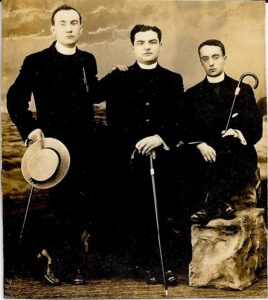
Happy to exercise the modest privileges and duties of a simple pastor, Father Marini was, nonetheless, not to remain completely free of greater responsibilities that hearkened back to earlier days. On February 19, 1945 he received a communication from Assistant General Joseph Hickey, O.S.A. informing him that “in conformity with the wishes of the Most Reverend Father General … I hereby appoint you Acting Commissary Provincial of the Italian Vice Province of the United States with all the powers and privileges attached to this office.” This was an assignment he had not expected nor desired, but which he carried out obediently for more than two years while continuing as pastor of the Pompeii parish. Finally, in January 1947, he wrote to the Prior General “I pray you release me from this duty. I am over 61, weak, (with) high blood pressure.” It would be a long wait before he was relieved of the burden, however. In November 1948, Father Hickey, by this time now Prior General of the Order, notified him that Father Mortimer Sullivan, O.S.A., the Villanova provincial, had agreed to assume the office of commissary. Marini, however, was appointed to become one of Sullivan’s counselors.
In August 1950, Father Marini departed for a lengthy stay of nearly three months in Italy. In the interim before his return, he was re-appointed counselor to the newly assigned commissary, Father Joseph Dougherty, O.S.A., who had succeeded Father Sullivan as the provincial of the Villanova Province. In the summer of 1951, Marini was asked to take on the role of acting treasurer of the vice-province. One year later, however, due to failing health, he asked to be free of administrative responsibilities and requested of the commissary permission to resign as pastor of Our Lady of Pompeii. In August 1952, Father Peter Toscani, O.S.A. assumed the position of pastor and Father Marini was finally relieved of all pastoral duties and freed to tend to the needs which his health required. Following a surprise farewell given him in October 1952 by parishioners in honor of his 68th birthday, he departed for Cuba where he remained until the following March. In April 1953, he was assigned to the community attached to Saint Mary’s Parish in East Vineland, New Jersey but without responsibilities to the parish. At the end of October of that year he flew to Rome and returned in mid-December, apparently in good spirits and enjoying, as one confrere noted, “a new spring of life.”
The following May, while visiting family in Long Island, New York, Father Marini was taken ill and hospitalized in Mary Immaculate Hospital in Jamaica, Queens. There he remained bedridden for the following eleven months and passed away on Easter Saturday, April 16, 1955. He was 69 years old and had served the Italian immigrant population, his fellow religious and the wider Church in the United States for 45 years. On Tuesday, April 26, 1955, the Feast Day of the patroness of the Italian Vice-Province, Our Mother of Good Counsel, he was laid to rest in Saint Mary’s Cemetery, East Vineland, following a Solemn Requiem Mass offered by commissary provincial, Father Anthony Cirami, O.S.A. in Saint Mary’s Church.
Father John Raimondi, O.S.A., in his funeral homily, spoke of his confrere and friend with words that resonated fully with friars and laity who had known Aurelio Marini whether as brother, pastor, religious superior or friend: calm, humble, serene, zealous, able, sensitive and full of compassion. As someone who had freely left the land of his birth to work with and among fellow expatriates, Father Marini knew well the challenges and trials of adjustment and adaptation which many of his confreres and parishioners dealt with each day and accompanied them with kindliness and skill in the best tradition of the Italian Mission. As Father Raimondi summarized, “All who had the pleasure of his acquaintance and all his higher superiors in America and across the sea have always looked at him with esteem, affection and veneration, and considered him the most representative figure of the vice-province.”
Fr. Michael Di Gregorio, O.S.A.
September 2024
