
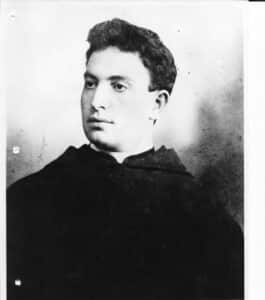
One of the little-known protagonists of Augustinian history in the United States is a friar whose name is largely unfamiliar to his confreres of the American Provinces today. This is true, no doubt, not only because of the brevity of his presence and ministry in this country, but also due to the eventual undoing of the mission he was instrumental in establishing. Nonetheless, his story deserves to be told and his memory preserved, if for no other reason than that he agreed to undertake, at a very young age and at significant personal cost, a bold adventure, and gave himself to it without reservation, helping to lay the foundation for what was to become an important arena of ministry among early 20th Century immigrants.
Early Days
Guglielmo Serafino Repetti was the only son of Domenico Repetti and Margherita Biglieri, born on August 15, 1872, in Cabella Ligure, a town of the Province of Alessandria in the Italian Piedmont region, located about 75 miles southeast of Turin. Domenico died when his son was three years old and Guglielmo and his five sisters were left to be raised by their mother alone, a conscientious and devoted woman whose sole concern now was to provide each of her children with a proper Christian upbringing. In November 1885, at the still delicate age of 13, Guglielmo entered the Augustinian minor seminary at Borgo a Buggiano, near Lucca, Italy. A few years later, after he had shown signs that he was fit for religious life, he was sent as a novice to Carpineto Romano not far from Rome, where he underwent a year of thorough preparation in the Augustinian way of life, its customs, traditions and history. At the completion of this period, he professed religious vows and was affiliated as a member of the Order’s Ligurian Province. His solemn profession took place on August 15, 1892, significant not only in that it was the Feast of Mary’s Assumption, but also Guglielmo’s twentieth birthday. He began studies to prepare for the priesthood at the Collegio Santa Monica in Rome, but due to poor health – a condition that caused frequent nosebleeds – he was advised to return to Tuscany to complete his education. He was ordained to the priesthood on Holy Saturday, March 30, 1895 in Pescia, a Tuscan city situated between Florence and Lucca.
Ministry
Father Repetti received his first assignement following ordination as assistant pastor at La Consolazione Church in Genoa. Later, he was transferred to the city of Savona where the friars had been active since the latter part of the 14th Century. His diligence in ministry did not go unnoticed by the Archbishop of Genoa who wanted to name Father Repetti pastor in Sturla, where the church of the Santissima Annunziata had once been under the care of the friars. However, the superiors of the Order had already chosen Father Repetti for another task, the specifics of which are found in two entries of the register of Prior General Sebastiano Martinelli.
The first entry, under the date of November 24, 1897, was explicit:
We transferred Father Guglilemo Repetti from the friary in Savona and directed that he be ready on the 16th of December, together with Father Angelo Caruso and Brother Bernardino Falconi to depart from the Port of Genoa, to administer the parish which was to be founded by the Reverend Archbishop of Philadelphia in the United States for the Italians there [1] according to what had previously been agreed upon between our Order and the Sacred Congregation of Propaganda Fide. [2]
On the 16th of the following month of December, the day the friars were to depart, a second entry appeared in the register. It was essentially a restatement of the earlier one, absent, however, the names of the friars involved. Attached to it was a list of eighteen regulations for their life in the new American mission. [3] Father Repetti’s specific responsibility in this new mission was to be pastor of the yet to be established parish.
In April 1896, Sebastiano Martinelli, already serving his seventh year as Prior General, was named by Pope Leo XIII as Apostolic Delegate to the United States. He assumed his new duties, while continuing to serve as superior of the Order, until a successor was elected to fill this latter position in 1898. It was in his role as Apostolic Delegate that Martinelli had been approached by the Archbishop of Philadelphia to help find religious to care for the Italians under his care. Archbishop Martinelli decided to send his own friars to take up this work.
When the day of his departure arrived, Father Repetti bid a tearful goodbye to his mother who, seeking to encourage and console her son, said with unintended irony, “going to America you are not going to your death.” [4] The sadness of the day was compounded by the fact that little more than a month earlier, one of Father Repetti’s sisters, Luigia, had passed away at the age of 37. [5]
Missionaries in a new land
Father Repetti and his companions arrived in the United States on December 30, 1897. Very quickly they set to work, met with the archbishop and learned from him the extent of their responsibilities. The first task was to find living quarters for themselves and a suitable place to construct a church. Not only did the work of exploration fall on their shoulders, but the expenses involved, apart from a small loan from Monsignor Ryan, would also be theirs. The raising of funds, therefore, immediately occupied the friars’ energy and ingenuity.
They lived for a short time in a rented house on 9th Street and then, later, at 819 Christian Street. The neighborhood already had two Catholic churches. One was the parish of Saint Mary Magdalen de’ Pazzi, the first church in the country established for the service of Italian immigrants. Its pastor, Father Antonio Isoleri, was like Father Repetti, from northern Italy, and his congregation was composed largely of Italians from the same region. In fact, the newer arrivals, Italians from the southern provinces, felt unwelcome there, as they did also in the parish of Saint Paul, which until then was serving a predominantly Irish population.
The decision was made not to build immediately a third church, but rather to purchase and renovate the old Saint Paul School building for temporary, mixed use as friary, church and an eventual parochial school. The rationale for this decision was largely due to the friars’ understanding that, at the termination of Father Isoleri’s pastorate, the buildings of Saint Mary Magdalen de’ Pazzi would be turned over to them. This, in fact, never materialized and became the subject for a serious rift between the Augustinians and Archbishop Ryan’s successor.
Saint Paul’s former school building, located midway between the other two churches, was purchased and renovations began. The church would bear the title of Our Lady of Good Counsel. Archbishop Ryan granted parish boundaries on February 1, 1899 and officially appointed Father Repetti its first pastor. The ministry offered by the friars met with an enthusiastic response on the part of the people, who were appreciative of the attention and care now being given to them. The young pastor was likewise filled with energy and enthusiasm in his ministry. As he soon became known as an eloquent and fluent preacher, he was called upon to speak in parishes far beyond the confines of ‘Little Italy’, as the neighborhood was called, in Manayunk, Germantown and Lenni, wherever clusters of Italians were to be found. He was also invited outside the archdiocese, as in May 1899, when he conducted a mission for the Italians of Lawrence, Massachusetts, who were being cared for by the Augustinians at Saint Laurence O’Toole Church.[6]
The Stone of Blessing
On May 21, 1899, the cornerstone of the new church was blessed by Archbishop Ryan before a crowd estimated at 10,000 people. Archbishop Martinelli, as a sign of his great support for this new initiative which he had been so personally instrumental in advancing, was also in attendance. A pleased and animated Father Repetti preached to his people in their native tongue, drawing an example from the Scriptural story of Jacob who fell asleep with his head resting on a stone. As the Lord instructed Jacob to consecrate that stone and erect an altar upon it so that he and his children might be blessed, so the dutiful pastor encouraged his people now to correspond to God’s grace so they might receive blessings as well.
One month later, on June 25th, a gilded cross was blessed by Good Counsel’s neighboring pastor, Father Michael Donovan, and raised on the spire of the new church. Several thousand people and a large number of clergy participated, with Father Repetti once again offering a sermon in Italian. No one then could have imagined that within another month they would gather yet a third time, but for a far less joyful reason.
Joys Turned to Sorrow
A particularly vicious outbreak of typhoid fever struck Philadelphia in 1898-99 which some people claimed was related to the arrival of soldiers in the city at the time of the Spanish-American War. The result was 948 deaths in 1899 within Philadelphia. [7]
Father Repetti fell victim to the dread disease and died on Wednesday, August 2, 1899. Though he had been ailing for some time he insisted on working until three weeks before his death when he was compelled to take to his bed. When his condition worsened, he was taken to Jefferson Hospital where he seemed to improve for a short time, but this brief rally was not to last long. He was not quite 27 years of age.
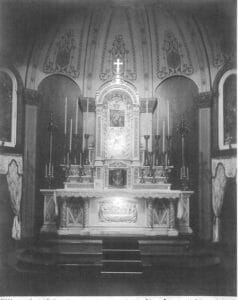
The exterior of the building that served as both worship site and friary was draped in mourning, as was the interior of the church proper. Beginning on Friday evening, August 4, the body of Father Repetti lay in state, where it was viewed by thousands. Though Father Donovan of neighboring Saint Paul Parish had offered the use of that church for the funeral services, since it was large and Our Lady of Good Counsel was not yet completed, the friars, grateful for the offer, nevertheless declined.
Saturday, August 5th was one of the warmest days of 1899, the temperature rising to a high of 94 degrees. The Archdiocesan newspaper, The Standard and Times, in its edition of August 12, 1899, reported,
“The body was attired in the robes of his order and rested in an oak casket surrounded by candelabra, in front of the main altar of the temporary chapel of Our Lady of Good Counsel. The edifice was crowded on Saturday morning long before the hour of service, notwithstanding that the heat was so intense that large candles on the altars bent almost double.”
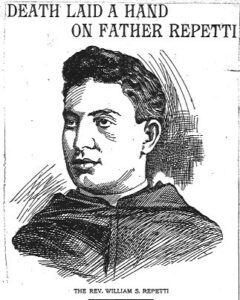
Bishop Prendergast presided over the recital of the Divine Office prior to the Solemn Requiem Mass, which was celebrated by Father James Coleman, O.S.A., assisted by Father Angelo Caruso, O.S.A., and Father Charles Fournier, a novice of the Order. Father Antonio Isoleri, pastor of the neighboring Italian parish, Saint Mary Magdalen de’ Pazzi, preached in Italian, and Father Michael Donovan, rector of Saint Paul’s Parish, spoke in English. Among the many mourners present were a number of friars of the Villanova Province, led by the Prior Provincial, John Fedigan, O.S.A., diocesan clergy and members of other religious communities.
Father Repetti’s body was laid to rest in the vault at Saint Augustine’s Church, Philadelphia, but was later placed in a new vault that was constructed in front of Our Lady of Good Counsel Church, marked by a marble monument and a half-bust of the deceased friar, and bearing this epitaph in Italian,
“Father Guglielmo Repetti, of Ligurian birth, exemplary religious of the Hermit Order of Saint Augustine, first pastor of this church, completely intent on the spiritual well-being of his fellow countrymen, died on August 2, 1899. His parishioners honor him with this monument.”
Some twenty years after the church had been closed at the direction of the Archbishop of Philadelphia, the body of Father Repetti remained there until July 31, 1956 when it was transferred to Saint Mary’s Cemetery, East Vineland, New Jersey, the community cemetery for the friars of the Italian Vice Province of Philadelphia. The monument, sadly, was not transferred, but was pulled down by a rope attached to a truck, the half-bust left abandoned on the ground.[8]
A month following his death, Father Repetti was memorialized in lines written by Margaret M. Halvey, and published in Our Lady of Good Counsel Magazine, a publication of the friars of the Villanova Province. [9]
The widow’s only son – men held their breath,
Powerless to voice the pathos of that death –
Stricken ‘mid strangers on the stranger soil,
The toiler in the springtime of his toil.
A mother’s well beloved, he had heard First,
from her lips, the Lord’s compelling word,
“Leave all thou lovest best and follow ME.”
For him, that pathway spanned the alien sea.
For such as he, the widow’s cherished one,
Was wailing once where set Judean sun,
As passed the mourners thro’ the gates of Naim.
When, lo! the Rabbi with His followers came!
“Weep not,” He said. Swift ceased the sob and tear.
“Arise!” – His Hand but touched the shrouded bier.
The youth arose to length of honored days,
And whilom mourners paused to pray and praise.
Is it that He hath ceased to understand,
O sorrowing mother in the far-off land,
The throes of human hearts like hers and thine,
That hearkening now, He maketh thee no sign?
Nay! Since that day of hopeless grief and tears,
Himself hath died, that Death might lose its fears;
That Faith might, ripened, rise to sterner test;
That Strength be ours, to say, “His Will is best.”
His hope is ours to know by other gates
Fairer than Naim’s of old the Master waits.
With crowding seraphim around Him there,
He hearks the anguished cry and heeds the prayer.
Unto that dear one – “Son,” He saith, “arise
To bliss eternal past the veiling skies;
Arise to Love’s o’erwhelming return
For heat and burden early braved and borne.”
Fr. Michael Di Gregorio, O.S.A
October 2024
[1] Letter of June 29, 1897 from P. J. Ryan to Most Rev. Sebastian Martinelli OSA
[2] (AGA) Fondo Archivio del Novecento.
[3] Ibid, December 10, 1897.
[4] Funeral homily of Father Isoleri, private papers
[5] Luigia Repetti, wife of Domenico Demergasso in
[6] W. A. Leahy, The Catholic Church in New England, p. 293
[7] Steven J, Peitzman, philadelphiaencyclopedia.org/archive/typhoid-fever-and-filtered-water/
[8] Il Progresso, August 7, 1956.
[9] September 1899, vol. IX, no. 6.
