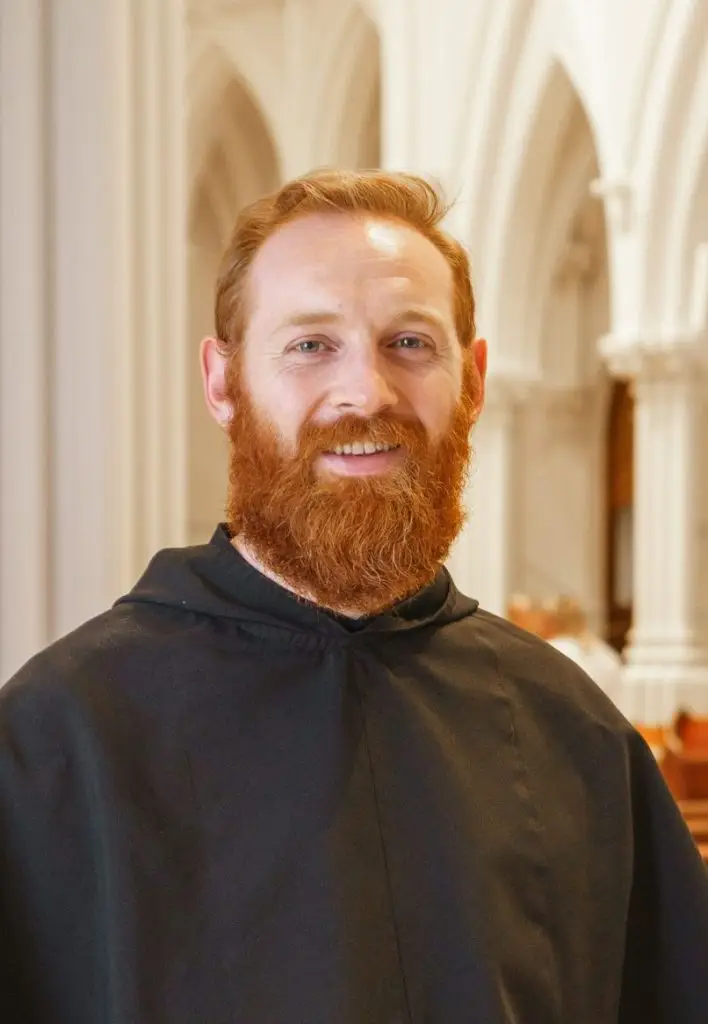
As a theology teacher, I regularly give exams to my students. As can be expected, some will not perform as well as others, and so I will often hear the request, “Fr. Riggs, could I re-take the exam? I’ll do better next time!” It’s a bold request, one that I often hesitate to accept. Typically, I allow it when the test proved to be particularly difficult for a significant number of students. While I may revisit this policy for the future, it is ever apparent that students will always try to do everything they can to get a higher grade.
Some of this translates to our own lives. Much like my students are trying to avoid academic death, most of us would like to be spared of eternal death, the consequence of the Sin of Adam and Eve. All of us have made mistakes in our past, some mild and some severe. We often wish that we would have acted differently, and yet our human weakness gets in the way. Saint Paul knows this well, that “those who are in the flesh cannot please God.”
But Saint Paul shares a message of hope! “Although the body is dead because of sin, the spirit is alive because of righteousness.” In other words, those who believe in Christ and in his resurrection, and allow Christ to dwell in our hearts, will avoid the fate of death, and will be raised to eternal life!
This may be hard for us to believe at times. Indeed, it was a challenge for Jesus’s disciples to wrap their heads and hearts around as well. Throughout the Gospel, we encounter a series of characters who struggle with the idea that death is not the final word for those who believe. The disciples are confused when Jesus says that he will go to awake Lazarus. Mary cries out that her brother would not have died if Jesus were there. Even Martha, who initially says she believes in Jesus as the sign of resurrection, only believes this is possible in the future, and not in the here and now (“Lord, by now there will be a stench! He’s been dead for four days!”)
Jesus is “perturbed” that all those who are closest to him, still have trouble believing his words. They struggle to accept that Jesus has the power to raise a person back from the dead at any moment. Yet, this is the power of the story of Lazarus: that in our own imperfect lives, we can experience the resurrection before we are raised on the last day.
For those of us in the Augustinian family, we know deep within our hearts that this is true, as Saint Augustine himself experienced a type of “Lazarus moment” in his own life. In his Confessions, Augustine shares several key details of his life that had kept him in a state of death: the famous incident when he and his friends steal the neighbor’s pears from his tree, his fixation on bodily pleasure and lust, his wayward beliefs during his forays with the Manichees. Augustine found himself in this state of death, with no power of his own to overcome it.
It wasn’t until his moment of conversion, when he found himself able to rise from such a state of spiritual death. He was a new man, a new creation, with a new spirit in Christ. On his own, he couldn’t overcome his restlessness and concupiscence. Only by allowing Christ to dwell in him was he able to rise and to live a new life destined for eternity.
Augustine’s journey not only reflects the raising of Lazarus, but also the journey of Israel. The prophet Ezekiel finds himself in a state of exile from the land God promised his people. A state that was the result of Israel’s turning away from the one true God in favor of other gods and of their own pursuits. As the Israelites wondered whether they would ever settle in their land again, God promises them new life, redemption, and a renewal of his promise. And sure enough, after about seventy years of exile, they rose from their state of despair and were able to return to the place where God dwelled: the city of Jerusalem.
We too find ourselves on a journey to the place where God dwells. A journey that involves a similar process of death and resurrection. Our old selves and our former ways of life come to pass, while a new self and a new way of life rises from the grave! For some of us, this takes the form of making small changes over time, slowly but continually renewing our spirit as it journeys towards the day we enter eternal life.
Yet for others, this journey is more intense. We see this unfold often in the stories of those who recover from alcohol addiction. Before, they existed in the grave, making choices that weaken the will and rupture relationships. But when they acknowledge this human frailty and allow a “higher power” to rule in their lives, they begin to live differently, they heal, and they rise to become a new person again. The change is so stark and dramatic that it is as if they have risen from the dead.
As we continue our Lenten journey from death to new life, we return to Jesus’s question to Martha, “Do you believe this?” Much like Martha, we may say that we believe in the resurrection, and yet are still concerned with the stench of the tomb. We may believe that we will be raised on the last day, but do we believe that we can rise from the dead while on earth, as Lazarus did? Do we believe that we can overcome some habitual sin in our lives before the last day? Do we believe that we can overcome our prejudices and grudges while sill on this earth? Do we believe that we are capable of change, to become a new creation?
If the ancient Israelites, Augustine, the many witnesses to recovery, and Lazarus himself can serve as an example, then we too can believe in new life here in this moment. We believe in the God of second chances. God is always eager to raise us up to new life. All we need to do is allow Jesus to rule our hearts so that he may raise us to live in his spirit.
Much like my students find hope when allowed to re-take an exam, we too find hope in Jesus that despite our sin and human weakness, he will redeem us and raise us. “I have promised, and I will do it, says the Lord.” Let us continue our journey with this hope, as we eagerly await the day of the resurrection, knowing that it is already happening in our midst.
“With the Lord there is mercy and fullness of redemption.”