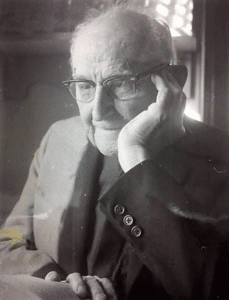
 To set out to tell the life story of Augustinian Father Leo Reichart is, tantamount to chronicle the history of Saint Rita of Cascia Parish in Philadelphia. At his death on January 26, 1979 at the venerable age of 95, Father Reichart had spent 64 years at Saint Rita of Cascia, 30 of them as pastor. His ministry spanned several generations and touched the lives of countless individuals and families who regarded him in every respect as their father in faith. His presence was a gentle and steady one, and memories of him have survived long after his passing.
Leo James Reichart was the second of the children of Augustus Reichart and Catherine Wummer. In addition to his four brothers and one sister, he had also a half-brother, the son of his father’s first wife, Emaline. The Reicharts were a family with deep roots in Pennsylvania, where Leo’s great-great-grandfather had been born in 1741, the very year that the local Catholic church of Bally had been founded and where generations of Reicharts had worshipped ever since.[1] Bally was the first German Catholic settlement in the original colonies, initially named Goshenhoppen, but renamed by its residents in 1883 for Jesuit Father Augustine Bally who was pastor of Most Blessed Sacrament Church there for forty-five years. Most Blessed Sacrament is the oldest Catholic church in Pennsylvania.
Leo was born in Bally on February 22, 1884. He was baptized in Most Blessed Sacrament Church and received his primary education in its parochial school. Interestingly, three other young men joined the Augustinians from this same parish which had no direct Augustinian connection: Fathers Edward and Raymond Stengel, and Father Francis Melcher.
Following his early education, Leo worked for a time as a tailor, and in 1903, having discerned a religious vocation, enrolled in the Augustinian Preparatory Scholasticate, Saint Rita Hall, on the campus of Villanova College. He was received there as a novice on July 4, 1907 and made his profession of simple vows one year later on July 6, 1908. He then was sent to Rome to pursue philosophical and theological studies at Saint Monica’s International College together with a large group of American classmates. There he professed solemn vows on October 18, 1911 and was ordained to the priesthood with seven other American friars at the Church of the Most Holy Trinity, Rome, on July 25, 1913 by Archbishop Giuseppe Ceppetelli. He offered his first Mass at the tomb of Saint Monica in the Basilica of Saint Augustine in the Eternal City the following day.
Upon his return to the United States in September 1913, Father Reichart taught Latin at Villanova for a year, and then, on June 20, 1914 was named assistant pastor at Our Mother of Consolation Parish, Chestnut Hill. His stay there was very brief, however, for four months later on October 30, 1914, shortly after the outbreak of World War I, he was transferred to Saint Rita Parish, South Philadelphia, where he served the people and the Order first as assistant pastor, and later at various times as prior of the community and from 1938 until 1968 as pastor. That same year, 1914, also saw Father Charles M. Driscoll, O.S.A. appointed prior and rector of Saint Rita and Father Thomas Roland, O.S.A., Father Reichart’s novitiate classmate, also as an assistant. Father Serafino Aurigemma, O.S.A., who had first been assigned to Saint Rita some years earlier, returned in 1914 for a second time. Though the parish had been founded in 1907, in part to assist in ministry to the large Italian population of the area, it was from its origins meant to include people of various ethnic backgrounds. The names of donors etched on the stained-glass windows of the upper church attest to the number of non-Italian families who were early parishioners and donors. Nevertheless, given the size of the local Italian community, the friars regularly preached and heard confession in Italian, and the parochial school of more than 1000 Italian and Italian American children were taught by Italian Sisters. Father Reichart and his several non-Italian confreres, fortunately, were all conversant with the language due to the years of study and ministry they had spent in Italy. Father Reichart’s particular charge was the Sunday School program. Subsequently, he founded and oversaw the parish’s Holy Name Society, as well.
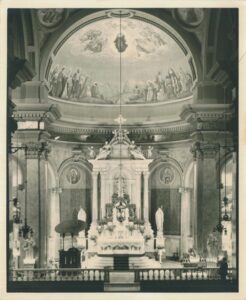 On May 16, 1915, just months after the then current friars’ arrival, Saint Rita Church was dedicated by Philadelphia’s Archbishop Edmond Prendergast with a solemn Mass sung by the Apostolic Delegate, Archbishop Giovanni Bonzano. The occasion marked a great step forward for the people and friars of the community as the completion of the church’s construction which had begun in 1907, had been delayed for seven long years as necessary funds were being raised. Even at the time of the dedication the church was not completely finished. Only two of the many stained-glass windows that were to tell the story of Saint Rita and other Augustinian saints, were in place. From September 1908 a basement chapel had been used for all the church’s sacramental needs.
The early years of ministry of the friars at Saint Rita were intense and were marked with continual activity as they sought to meet the needs of a largely immigrant population acclimating to the customs and patterns of American life in an urban setting. These were the days when Saint Rita Parish encompassed all the Italians from Market Street to the Navy Yard, between the river and 12th Street. Just a few years in, the outbreak of the great influenza epidemic of 1918 created a state of emergency which not only directed the attention and activity of everyday living but claimed the lives of an estimated 50 million people worldwide, 12,000 of them in the city of Philadelphia. At Saint Rita alone, the friars celebrated the funerals of 212 victims in a matter of months.
The following year, with the tragic consequences of the epidemic diminishing, activities of Saint Rita, as everywhere, began to return to normal. A building adjoining the church was purchased as a residence for the friars and two years later, the building attached to it was also acquired, now allowing the former house of the Augustinians to become a convent for the sisters. In the interim, Father Matthew Corcoran, O.S.A., who had arrived as an assistant in 1916, was named pastor.
Occasional special events engaged the friars, offering some diversion from the sacramental and educational duties that ordinarily filled their days. In 1924, Columbus Hospital, under the direction of Mother Cabrini’s Missionaries of the Sacred Heart, opened across the street from the church. The friars at Saint Rita were frequent ministers there including as celebrants of Mass there each morning. The following year, the Apostolic Delegate, Archbishop Fumasoni-Biondi, paid a three-day visit to Saint Rita where he celebrated one of the feast day Masses and confirmed 1200 children. In 1926, Father Corcoran published statistics of the parish which give clarity to the types and amount of ministry that occupied the friars. According to this document 19,000 people were listed on the parish rolls, of whom 340 were on the sick list and visited an average of 9 times a year. Confessions were heard every morning and evening of the week for a total of 80,000 a year, and five Masses were offered daily, not including funerals and weddings. Devotions were held every evening of the week, twice in Italian and twice in English, and three days a week devotions to Saint Rita were held.
In June 1930, Father Corcoran passed away in Saint Joseph Hospital after a six-month illness and was succeeded as pastor by Father Thomas Roland who had ministered previously at Saint Rita together with Father Reichart from 1914 to 1921. Subsequently, he had been assigned to Saint Nicholas of Tolentine Parish in the Bronx. Now he returned to Saint Rita where he would remain for the next five years until 1935, when Father Reichart would follow him as prior and pastor at Saint Rita.
The very year of Father Reichart’s appointment as pastor coincided with two other events that were significant in his personal life as well as in the life of the parish. In July, he marked the 25th anniversary of his ordination to the priesthood, and little more than one month later, Father John Frediani, O.S.A., a native of Tuscany, arrived as one of his assistants. Observers quickly noted how the playful and lighthearted disposition of this newest confrere contrasted with the devout, sincere and earnest character of Father Reichart, but the 33 years they were to spend together at Saint Rita’s would give evidence of the complementarity of their personalities and the affability they each possessed. The two friars became legendary, each in his own right and for his particular contribution.
Father Reichart assumed his new responsibility as pastor quite effortlessly. He needed no lead time in which to familiarize himself with his people, nor they him. Many of the younger parishioners had grown up with him as a stable presence for as long as they could remember, and the older ones had seen him grow in his priesthood as he served them pastorally and sacramentally. In 1935, Saint Rita Parish was still large and vibrant, organizations and societies for adults, as well as children, were numerous and the parish itself was an important center not only of religious practices, but of social activity as well. The celebration of Masses, baptisms, funerals and weddings, calls to the sick, anointings, the daily hearing of confessions, novenas and devotions, visits to school classrooms were the typical events that regularly occupied the lives of the friars who numbered, at times, as many as five or six. The experience of the Great Depression challenged the friars as it did the people they served, but especially in their efforts to assist the many who were now without work and lacking the means to feed their families and properly care for their children. The side door leading to Saint Rita’s kitchen became a frequented and anonymous haven for anyone in need of a sandwich, and the indulgent disregard for payment of a bill or two for school children, the prerogative of a kindhearted pastor.
The major event each year, of course, was the solemn novena in preparation for the patronal feast in May which brought thousands of individuals to the church, both parishioners and visitors, to honor Saint Rita. A report for the year 1940 numbered attendance at twelve novena services daily for nine consecutive days to between 12,000 and 15,000 persons with three Solemn High Masses sung on the Feast Day, 17,000 roses blessed and distributed, and Solemn Vespers sung in both the upper and lower church. While the work of the pastor, his regular assistants and additional extra friars was greatly increased during such periods, the satisfaction of seeing so many people frequent the sacraments and pay homage to Saint Rita energized someone as devout and dedicated as Father Reichart for months after.
As pastor, Father Reichart was now responsible for all things administrative in addition to his practice of zealous hands-on pastoral ministry. In 1941, he had the upper church painted, and made renovations to continue the embellishment of its interior. He commissioned the installation of two murals in and around the sanctuary. One was the glorification of Saint Rita placed in the ceiling above the altar and the other of the Blessed Trinity above the entrance to the apse. The following year, he had four circular paintings of Our Mother of Good Counsel, Saint Augustine, Saint Monica and Saint Nicholas of Tolentine added on the walls of the sanctuary.
In 1944, Father Henry Caffrey, O.S.A. was named prior of the religious community at Saint Rita while Father Reichart remained responsible to direct the parish. The following year, the pastor launched a drive for the construction of a parish hall, and in 1945 he oversaw the beginning of construction on a new school building. Up until this time, the school had been conducted in several attached homes that had been refitted as classrooms adjoining the church. On September 16, 1951, Father Reichart was pleased to welcome the Prior General, Father Joseph Hickey, who dedicated the now completed building, while the Prior Provincial, Father Joseph Dougherty, addressed the proud parishioners gathered for the event.
Over the course of the six decades which he spent at Saint Rita’s, Father Reichart’s life and ministry were linked with that of a great number of friars who served either as his colleagues, assistants or superiors. They included both native born American friars as well as Italians and Maltese. A singular distinction of his character and temperament was his ability to live in harmony with all, especially remarkable in view of his role as leader for many years. A universal explanation for the admiration and respect which his confreres displayed toward him was the sincerity and fidelity with which he carried out his ministry and the fact that he led always and especially by example. His affection was expressed each evening as he passed among them with his customary greeting, “Buon riposo, buon riposo, have a good rest, have a good rest.”
In the early decades of the parish’s busy life, thanks in part to the clear witness of the friars’ dedicated service to their people, the seeds of many religious vocations were sown in the lives of the parishioners. Father Reichart and his community rejoiced to see the results of many of these young men ordained and return to Saint Rita’s to celebrate their First Mass. Between 1932 and 1952, there were no less than ten young Augustinians, almost all of them also alumni of the parochial school, who did so. The names Pacitto, Rongione, Porreca, Monte, Fittipaldi, DeCicco, Caniglia and Giovinetti are still familiar to many friars today.
The ever-vigilant pastor also had challenges to face throughout the years, especially and not surprisingly, during the period of his pastorate. These included the death of family members, as well as that of several of the friars of his community, among whom were Father Henry Conway, O.S.A. who died while serving as prior at Saint Rita’s; Father Charles Brown, O.S.A. an assistant; and Father Sylvester Martin, O.S.A., likewise an assistant for fifteen years. Father Reichart saw each of these significant colleagues and fellow religious buried from Saint Rita’s.
The greatest fear any pastor might experience was made real for Father Reichart on Tuesday, August 19, 1946, when boys playing with candles at the shrine of Our Mother of Good Counsel started a fire in the church. Though damage was done to the shrine and some of the pews, and the painting and walls were marred by the smoke and soot, the overall result, fortunately, was not as serious as it might have been. A grateful pastor offered extra prayers of thanksgiving that evening.
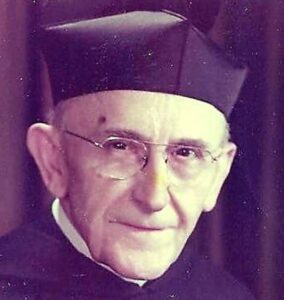 The year 1957 marked the fiftieth anniversary of the founding of Saint Rita’s, and Father Reichart wished to have his parishioners celebrate the event with great festivity, pride and gratitude to God. He arranged for a Solemn Pontifical Mass to be celebrated on Sunday, October 6 by Augustinian Bishop Peter Canisius van Lierde, vicar general of Vatican City and Papal Sacristan to Pius XII, with many friars from surrounding communities in attendance and Augustinian Scholastics from Villanova as servers and cantors. For the congregation that filled the church, the celebration was an important sign of a vibrant parish come of age. Two days later, a Jubilee Dinner at the Bellevue-Stratford completed the anniversary’s major events.[2]
Five years following the church’s fiftieth jubilee, it was Father Reichart’s turn to celebrate a significant personal anniversary of his own, the golden anniversary of his ordination as a priest. On July 21, 1963 Archbishop John J. Krol presided at the jubilarian’s Solemn High Mass of Thanksgiving at Saint Rita’s which, once again saw gathered many of Father’s Augustinian confreres, diocesan clergy and devoted parishioners. Several days later, he was feted at a testimonial dinner in his honor that drew 1,100 friends and admirers of the jubilarian led by Philadelphia’s Mayor James Tate who served as dinner chairman.[3]
In 1968, at the age of 84, after more than five decades of joyful, faithful service to God and to the people of South Philadelphia, Father Reichart stepped away from the post of leadership. He did not, however, leave Saint Rita’s, lay aside his ministry, nor forsake the affection and commitment he had for so long demonstrated toward his beloved people. He could still be seen walking the streets with his priestly stole around his neck bringing the sacraments of the Church to the sick and elderly, many of them younger than himself. It was not unusual at times to see him outside the friary flagging down a police car – which he impishly mistook with regularity for a taxi – to take him to a more distant person in need. The obliging “chauffeurs” generously and happily accompanied him to his destination.
On November 21, 1968 a testimonial dinner was held in the now familiar Grand Ballroom of the Bellevue-Stratford Hotel in observance of Father Reichart’s retirement and designation as Pastor Emeritus. Once again, gathered to pay him honor and to express the good wishes of a grateful Order, Church and city, were the prior provincial of the Augustinians, representatives of the archdiocese, the Order of Sons of Italy, City Council and Philadelphia’s mayor.
It had been Father Reichart’s wish to remain at Saint Rita’s when his pastorate had ended, rather than retire to the monastery at Villanova which was possible for him. He saw two pastors follow him, Father Joseph Duffey, O.S.A., his immediate successor in 1968, and Father James Galligan, O.S.A. who arrived in 1975. It is not always easy for a former pastor to let go of the reins and allow his successor full freedom to develop his own style of leadership, make his own decisions and sometimes change the direction and practices he had adopted. Father Reichart, however, had learned how to let go of command, and lived in complete serenity, contentment and support of the friars who succeeded him. He continued to celebrate Mass seven days a week, to visit hospitals and bring communion to shut-ins — the things that he truly wanted to do. “If I could start all over again,” he said to a reporter in 1974, “I would still be a parish priest. A priest still must do what he always did: listen.”[4]
On the occasion of his 90th birthday in 1974, some 700 guests honored him at a reception hosted by the senior citizen’s club of the parish. It was obvious that he loved celebrations, probably, most of all, because he loved people and not because he enjoyed being the center of attention. As his long-standing confrere and associate in ministry, Father Frediani, said of him, “He’s a very humble man, not a bragger … He treated everyone alike, the rich and poor, bad and good. He was always fair.” [5]
On his 92nd birthday in 1976, one more celebration offered parishioners, confreres and friends another opportunity to demonstrate their grateful affection for him, this time at legendary Palumbo’s Restaurant of South Philadelphia. In his own remarks on the occasion, Father spoke simply and clearly of what was most important to him, and which all those present could surely affirm about him: prayer. “People prayed much more in my time. People dropped in to pray at Saint Rita’s all day long. I’m talking about many, many years ago, back before the automobile. There were horse-drawn carriages on Broad Street back then and they would stop at the curb and people would go into the church and pray… We’re a poor parish,” he continued. “All day long people run in the rectory with all kinds of trouble. Sometimes at night people knock on the door begging for something to eat. What we have to do is get the people of the parish praying again, praying together. That’s the best way to let God Almighty know we can use a little help.” [6] Who could argue with him about that?
Shortly after, in 1977, as his health began to fail and the friars at Saint Rita recognized that they were unable to give him the care and attention he deserved, he took up residence at the Villa of Divine Providence in Lansdale where another friar, Father Henry Caffrey, O.S.A., who had lived with Father Reichart as prior at Saint Rita’s in the mid-1940’s was also living. It was at the Villa that Father died on January 26, 1979, at the age of 95. Now was done for him, what he himself had done for hundreds upon hundreds of people over the years as his body lay in the center aisle of his beloved Saint Rita’s Church. On Tuesday, January 30, Mass was celebrated in the presence of a saddened but grateful congregation of many people who had known him all their lives and for whom he had been and would remain, father, teacher, counselor, benefactor, inspiration and model. One parishioner expressed the opinion of many others when she said,
“Father was a simple, innocent, undemanding, loving and thoroughly kind man, who loved nothing more than to spend hours with the people he loved, in prayer with his God or with his parishioners. His contentment was contagious… He had many friends in many places, but his parishioners were his children, his special love, and his total ambition was to serve them and bring them to God.” [7]
The body of Father Reichart rests in the Augustinian Plot of Calvary Cemetery in West Conshohocken, Pa. alongside the scores of friars with whom he had shared life and ministry at Saint Rita’s, but the memory of his joy-filled and gentle heart continues on in the memories of those who were the recipients and witnesses of his bountiful life.
Michael Di Gregorio, O.S.A.
October 16, 2024
[1] Fr. Thomas Roland, OSA writes in the Golden Jubilee Booklet honoring Father Reichart that the date of the first Reichart buried in the local graveyard is 1718.
[2] The Philadelphia Inquirer, Oct. 7, 1957, p. 11.
[3] The Philadelphia Inquirer, Jul 17, 1963, p. 44.
[4] Philadelphia Daily News, February 22, 1974, page 49.
[5] Philadelphia Daily News, February 14, 1973, page 2.
[6] The Philadelphia Inquirer, March 2, 1976, p 9.
[7] Chris Spagna as quoted in The Magnificat, vol. 4, no. 1, March 1979
