
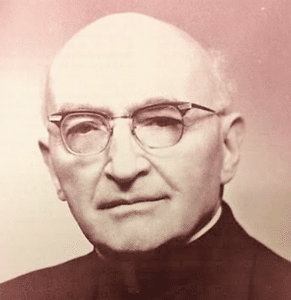
Francesco Lorenzo Andolfi was born in the town of Roccalvecce, Viterbo, Italy, the oldest of five children of Pietro Andolfi and Elisabetta Marcucci. According to civil records of the town, Francesco was born on December 22, 1888, though in later documents he himself regularly reported the date as December 24th. Just a month after his ninth birthday, his mother, a schoolteacher, died at the age of 38, leaving his father and the parish priest, Don Giovanni Sonni, to guide him in his vocation to religious life. His choice was the Augustinian Order whose long history in Viterbo was well known. In September 1903, he arrived at the friary of Santa Maria in Selva in Borgo a Buggiano, Tuscany, for his initial experience in religious life, followed shortly thereafter with his entrance into the Augustinian novitiate in Carpineto Romano, south of Rome. He made his profession of vows as a member of the Roman Province of the Order on Christmas Day 1904, and was known from this time onward simply by the name Lorenzo. He then returned to Viterbo and the friary of Santissima Trinità to begin his studies in philosophy. This first phase of academic studies completed, he was sent to the Collegio Santa Monica in Rome for theology, and on July 25, 1911 was ordained to the priesthood at the Church of Saint Apollinare in that city. The following day he celebrated his first Solemn Mass at the Order’s Basilica of Saint Augustine in Rome.
Father Andolfi was 37 years old when he sailed from Naples on the SS Roma with the Italian Augustinian Parish of Madonna del Buon Consiglio in South Philadelphia as his destination. Confreres of his had begun the Mission in 1898 at the invitation of Archbishop Patrick Ryan and through the generous collaboration of the archbishop’s friend, the Augustinian Order’s Prior General and more recently the Vatican’s Apostolic Delegate as well, Sebastiano Martinelli, O.S.A. The archbishop had long sought the assistance of a religious congregation to assist him in ministry to the great number of Italian immigrants who were entering the United States and more specifically, the Archdiocese of Philadelphia, at the turn of the century. Archbishop Martinelli, who had been named only recently to his new post in Washington, D.C., promised to provide Archbishop Ryan with the help he needed. In 1898 three pioneer friars left Italy to found Buon Consiglio Church in the heart of the Italian district just off Christian Street in South Philadelphia. In the years prior to Father Andolfi’s arrival, some thirty friars had served the Mission, several of them having spent their remaining years on earth doing so, others eventually leaving to return to Italy or to pursue other paths. Almost three decades of labor had seen the Mission grow outward from Buon Consiglio to the establishment of a second church, Saint Nicholas of Tolentine in 1912, as well as the acceptance of the first American-born candidate for the Mission in 1921, and the elevation of the Mission to the status of a vice-province of the Augustinian Order in 1925. It was precisely during this last phase of development that Father Andolfi entered the scene, and within months of his arrival, he was placed in charge of the church of Saint Nicholas of Tolentine. Because it was still a mission chapel of Buon Consiglio and not an independent parish, Father Andolfi was not properly speaking the pastor, though his people considered him to be so, for he did exercise immediate oversight for the church and its activities. He would remain responsible for Saint Nicholas for the next five years.
Young Father Andolfi’s intentions regarding his commitment to the vice province and to the life he had begun in America seem to have been clear even at this early stage. He made application to become a United States citizen on May 3, 1927, only months after his arrival, though he would take his oath of allegiance only five years later on March 31, 1932. But a great deal would transpire in terms of his ministry before that oath was made!
In June 1927, shortly after his assignment to Saint Nicholas, Father Andolfi received a letter from Father Francis Tourscher O.S.A., secretary of the Province of Saint Thomas of Villanova, with what must have been a surprising message,
“A priest is needed in the parish of Holy Rosary, Lawrence. This need is urgent. The Father Provincial has decided to loan your service temporarily to the Rector of Holy Rosary. You are hereby ordered to report to Fr. W.W. Donovan at Holy Rosary, 35 Essex Street, Lawrence, Saturday, June 25, 1927 by order of the Provincial. P.S. You will remain at Holy Rosary to await the decision of the Most Rev. Fr. General with whom the Father Provincial is communicating on the question of the transfer and temporary loan of services.”
The superior of the Saint Thomas of Villanova Province at the time was Father Daniel Heron, O.S.A. who was also serving as the prior general’s appointed commissary provincial of the Italian vice-province and who, therefore, had certain legitimate authority regarding its friars. This fact, however, did not prevent a somewhat heated conversation from ensuing as to Heron’s right to issue his directive to Father Andolfi without the explicit previous consent of the prior general himself. Several friars of the vice-province addressed a letter questioning Father Heron in this regard and indicating that it was within their rights to appeal to the prior general, though they would honor the provincial’s decision in the interim. Father Agostino Bonanni, O.S.A., the visitator general for the vice-province residing at Buon Consiglio, made his case against Father Heron’s move quite emphatically. In October 1927, he relayed the message that the prior general had determined that Father Andolfi should remain in Philadelphia. By the time Bonanni wrote his letter, however, the point had become moot since Andolfi had returned to Buon Consiglio on October 3rd and had resumed his duties at Saint Nicholas. Whatever the situation had been that made his relocation to Lawrence so necessary seems to have faded by this time.
From the founding of Saint Nicholas in 1923, up until possibly the raising of the Italian Mission to the status of a vice-province in 1925, the friars who ministered at Saint Nicholas continued to live at Buon Consiglio where they formed a single religious community with their confreres at the mother church there. On July 3, 1928, however, Father Andolfi was named prior, pastor and sacristan at Saint Nicholas, the office of prior suggesting that a new community had definitely been formed at that location. The census of 1930 shows that he was living there together with two other friars, Fathers Claudio Fabrizi O.S.A., and Francis Paesani O.S.A. While a great concern of the parish during these years was paying off the heavy burden of debt remaining from the construction of the parish school which his predecessor had built, Father Andolfi was able to see the completion on the work of a new residence for the community now living at 9th and Watkins Street in 1932. The satisfaction of the debt and the new construction were particularly graced accomplishments for the people and friars of Saint Nicholas under the leadership of a prudent and practiced pastor, given the challenges of the Great Depression in which they unfolded.
In 1933, Father Andolfi asked to be relieved of his duties as pastor and was assigned to Our Lady of Pompeii Church in Dobbs Ferry, New York. Our Lady of Pompeii was a parish of Italian families in Westchester County and had been administered by priests of the Archdiocese of New York from its founding in 1922 through the specific interest and intervention of Mother Frances Cabrini. Father Aurelio Marini, O.S.A., who became superior of the vice province in 1928 had written to Cardinal Hayes early in his term inquiring as to the possibility of opening a house of the vice-province in the Archdiocese of New York. The cardinal’s response was negative at the time, but in 1931 the Dobbs Ferry parish became available, and the friars soon assumed responsibility for it.
Father Andolfi’s stay in Dobbs Ferry was to be a brief one of less than two years duration. It was during this period that he received notice of his unexpected appointment as commissary provincial of the vice-province. The news of his selection was communicated in a letter of February 12, 1934 from Rome, assigning him to succeed Father Marini who, no doubt, was happy to be relieved of the position he had held for six years, especially following the turbulent months of controversy caused by the Philadelphia cardinal’s decision to close the original foundation of the Italian Mission, Buon Consiglio Church, in 1933. That ruling of Cardinal Dougherty had resulted in violent protests on the part of parishioners, animosity toward Father Marini who was Buon Consiglio’s pastor as well as commissary, and the eventual appeal of parishioners to both Rome and the American courts, [1] all to no avail.
On April 19, 1934, Augustinian Prior General Clement Fuhl wrote at length to express his gratitude to Father Andolfi for accepting his new appointment to leadership and the nomination of Fathers Ambrogio Colorito and Aurelio Marini as his counselors. He took the opportunity, as well, to comment encouragingly and in depth concerning a request that the vice-province accept responsibility for an Italian-speaking parish in the diocese of Rockford, Illinois. [2] The prior general saw this as a further opportunity for the vice-province to expand beyond the confines of Philadelphia, while faithfully maintaining its mission to serve the Italian American population. In a spirit that was particularly characteristic of Father Fuhl, he gently but persuasively pressed for the faithful adherence to the obligations of religious life in this new location should it materialize. The letter ended with the generous granting of various permissions for several of the friars of the vice-province and his own favorable endorsement of the founding of a mission band for Italian parishes. This last initiative was to be undertaken with the collaboration of Father Lorenzo Spirali, O.S.A., a member of the Villanova Province who, though serving as econome general of the Order at the time, would be granted leave to begin such an endeavor. [3]
The responsibilities that Father Andolfi inherited as superior of the Italian vice-province were based essentially on the December 31, 1925 letter which Prior General Eustasius Esteban addressed “to the most reverend prior provincial of the Province of Saint Thomas of Villanova in the United States of America and the commissary provincial of the Vice Province of Philadelphia of the Blessed Virgin Mary of Good Counsel,” establishing the two friaries of Buon Consiglio and Saint Nicholas as the new vice-province. Among the points he enumerated in his letter were the nomination of the Villanova provincial as the commissary provincial pro tempore, as well as the nomination of two counselors and the procedure for choosing officials of the new circumscription. Father Esteban concluded with an explicit order that all were to accept this decree in virtue of holy obedience, a strong but not uncommon conclusion to formal pronouncements of the time. [4] By the time Father Andolfi had taken up the role of commissary in 1934, only the second member of the vice-province to do so, three additional houses had been added to the list of those constituting the vice-province as originally founded: that of Our Lady of Pompeii in Dobbs Ferry and the parishes of Saint Mary and Our Lady of Pompeii, both in Vineland, New Jersey.
In 1935, two new tasks were added to Father Andolfi’s principal duty as major superior of the vice-province. He left Our Lady of Pompeii Parish in Dobbs Ferry to become pastor of Holy Rosary Parish in Lawrence, Massachusetts, as well as prior of the Augustinian community there. As noted earlier, this was not his first appointment to the parish, but it would last far longer than his three months stay in 1927. In fact, he would remain there as pastor until his death twenty-seven years later.
Holy Rosary was a parish under the care of the Province of Saint Thomas of Villanova, such that Father Andolfi’s assignment to leadership there was a bit unusual, in that he was not only a member of a different circumscription of the Order, but that circumscription’s major superior as well. Undoubtedly, it was another urgent need that brought Father Andolfi to Lawrence again. Holy Rosary’s founding pastor, Father Mariano Milanese, O.S.A., had run into difficulty with the Cardinal Archbishop of Boston, William O’Connell, principally over the accumulation of the parish’s indebtedness of over $300,000, but also owing to Father Milanese’s independent approach to leadership and decision-making, which oftentimes bypassed archdiocesan policy, to the cardinal’s great displeasure. For several years the cardinal had been calling for the provincial to remove Father Milanese [5] and a series of letters, followed by meetings of the archbishop, the provincial and the assistant general resulted in the matter being brought to the Order’s curia and to the Congregation for Religious. While the case was being passed through appropriate channels, the provincial and council appointed a succession of friars to serve as administrators or procurators of the parish in August and October 1933. [6] Finally, on June 21, 1935 assistant general Joseph Hickey, O.S.A. made a canonical visit to Holy Rosary, which he treated of in his report to the Villanova provincial, Father Mortimer Sullivan who, five days later, in a meeting with his council, proposed the transfer of the pastor, Father Milanese, pro tempore and the appointment of Father Andolfi to replace him. In the interim, the latter had written a letter accepting Father Sullivan’s proposal under certain conditions. The council, relieved to have found Father Andolfi willing to accept the position and bring a most difficult situation to conclusion, agreed to his terms by unanimous consent and approved his appointment as prior and pastor. [7]
Father Milanese was relieved of his duties in July 1935 and Father Andolfi reported there the same month [8] with four other friars to assist him, one of whom was Father Aurelio Marini, a companion from their student days in Rome who had been the former pastor at Buon Consiglio as well as Father Andolfi’s predecessor as commissary provincial.

Father Andolfi’s assignment as pastor of Holy Rosary was, from the start, by no means an easy one. On the one hand, he had to deal for a time with Father Milanese’s continued presence in the city of Lawrence. The former pastor had not stepped away from his position willingly nor easily and tried repeatedly to argue for his continued participation in the life of Holy Rosary, even if without any exercise of responsibility. After 33 years spent cultivating and growing the faith community he had founded, it was not surprising that his separation from it and his removal far from the city would be difficult for him. This had been his one and only home and place of ministry since coming to the United States as a twenty-two-year-old friar, ordained a mere four months and immediately thrust into a position of leadership. But difficult, as well, was the burden placed on his successor. There were those who opposed Father Milanese’s removal and protested Father Andolfi’s appointment, certainly not for any motive that could be considered personally directed toward the new pastor, however. Happily, he was able to report to the prior provincial the day following his first Sunday there, “no serious incidents occurred yesterday … (though) a boycott was attempted at all masses, unsuccessfully.” [9]
While the issue concerning Father Milanese’s delayed transfer to his assignment to the Villanova monastery community would soon be resolved, the more difficult and long-term burden that would continue to challenge his successor was the sizable debt on the parish which, combined with the ordinary expenses of maintaining a church, a mission chapel, a school, a convent of sisters and a friary, was a formidable task. Nevertheless, Father Andolfi showed his ability with patience and resolve. Moreover, the full burden of indebtedness did not fall entirely on Holy Rosary. An arrangement had been made with the archdiocese whereby each of the eight parishes in the region under the care of the Augustinians would participate in paying it down.
Soon the people of Holy Rosary, indeed, of all of Lawrence, would come to appreciate the talent of the parish’s new pastor, as well as his gentle, friendly temperament and pastoral sensitivity. Within weeks of his arrival, Father Andolfi, seeing the hardship encountered by the Italian-speaking families of the neighboring town of Methuen in traveling to Lawrence for Mass and the sacraments, began to provide these services there as well. He quickly initiated the establishment of a mission chapel dedicated to Saint Lucy, and on Christmas Day, 1935, he celebrated the first Mass in the newly renovated structure. Two decades later he had the satisfaction of seeing Saint Lucy become an independent parish.
Meanwhile, the affairs of the vice-province continued to fall under Father Andolfi’s watchful care in his role as commissary provincial. At the end of December 1934, one of the Maltese friars ministering in the vice-province, Father Joseph Bugeia O.S.A., who had been prior of the community of Dobbs Ferry, resigned his office and asked to be assigned to the Villanova Province. His transfer, as well as the departure of other friars from the vice-province, for whatever reason, always presented a challenge to the small cadre of personnel available for service in one of the communities under the commissary’s care, and, therefore, a cause of disquiet for him. However, there were also signs of hope and growth that came. In 1935, there was the admission of a candidate to postulancy and in May 1936, the commissary had the joy of receiving the profession of vows of Brother Jerome D’Ambra O.S.A., in New Hamburg, New York. Two months later, Fathers Anthony Cirami O.S.A., and Louis DiOrio O.S.A., the first two American-born priests of the vice-province were ordained and sent to Saint Nicholas of Tolentine in Philadelphia to begin their ministry.
On the occasion of the Silver Jubilee of his ordination in 1936, Father Andolfi returned to Italy to celebrate the event in his home parish in Roccalvecce among his siblings and the many friends and relatives among whom he had discerned his vocation and exercised ministry before settling in America. What a variety of settings and responsibilities had filled those first twenty-five years!
In 1938, in a letter dated December 17, Prior General Carlo Pasquini informed Father Andolfi that he had been confirmed for another term as commissary provincial with the unanimous consent of the curia. [10] From the start of his combined duties as commissary and pastor and prior of Holy Rosary in 1934, Father Andolfi had Father Marini to assist him, not only as one of his counselors, but beginning in 1935, as a member of his local community as well. In August 1939, however, as commissary he found it necessary to appoint Father Marini pastor of the Dobbs Ferry parish. While three other Italian-speaking friars were still at Holy Rosary to assist him with parish responsibilities, he was now without the familiar rapport he enjoyed with this close friend and confidant. Father Andolfi would remain pastor of Holy Rosary for the remainder of his life but would be freed of the office of prior or superior of the local Augustinian community for various intervals as required by the norms of the Order which prohibited a friar from occupying this office for more than two consecutive three-year terms.
Father Andolfi wrote to the assistant general of the Order early in 1941 seeking advice on personnel matters within the vice province, and candidly expressed at the same time his desire to be relieved of the office of commissary and to withdraw personally from the Italian American circumscription. He went so far, in fact, as to suggest that the vice province be absorbed into the Villanova Province. This was not a novel idea on his part, however, as other friars had recommended the same action from time to time from the earliest days of the Mission. He stated further, that if the suggestion of assimilation were not acceptable to Roman authorities, young Father Cirami be appointed commissary in his place. [11] In a return letter, Assistant General Joseph Hickey informed the commissary that his resignation would be accepted if he insisted, but the request was made that he retain his office for a little longer, at least until a decision could be made as to a possible successor. Father Andolfi agreed and, to his dismay, continued on as commissary for another seven years! The vice province, too, remained an independent entity for several decades more.
While awaiting a response to his several suggestions, Father Andolfi inquired as to the possibility of personally transferring to the Villanova Province, and early in 1945 he received word from Villanova’s province secretary that his request had been favorably received, though the final decision would rest with the prior general. In 1947, while visiting his family in Italy, Father Andolfi met with the prior provincial of the Roman Province, to which he was still juridically affiliated, and this superior’s consent paved the way for the definitory of the Villanova Province to offer its approval to Father Andolfi’s request. Once the agreement of all parties had been received, Father Joseph Hickey, now Prior General and himself a member of the Villanova Province, approved the transfer. Father Lorenzo Andolfi was formally affiliated to the Province of Saint Thomas of Villanova by a decision of the Villanova provincial council on October 14, 1947, [12] and shortly thereafter officially tendered his resignation as commissary which this time was accepted All his attention and efforts now were given to Holy Rosary and its increasing needs.
As the parish grew under his administration, Father’s pastoral and managerial vision was directed in a special way toward projects that required expansion of facilities and programs. In 1943, he purchased property for a new convent for the Notre Dame Sisters who conducted the parish school. Some years later he enlarged this residence as well. In the early months of 1948, he sent letters to the chancellor of the archdiocese and to the secretary of the province requesting permission to purchase property for a parish recreational center. Permission was granted to expend $45,000 for this purpose and the work of renovating the property’s garage for the needs of the youth began. Two years later he sought authorization, as well, to buy land adjoining the school to provide an urgently needed children’s playground. In this, too, he received a positive response. In 1951, to his great satisfaction, the Venerini Sisters who had been educating the children of the parish since 1909, opened a nursery that significantly benefited parish families.
The year 1951 also marked the 40th anniversary of Father Andolfi’s ordination and just over fifteen years of ministry as pastor of Holy Rosary. In October, following a visit to his family in Italy, he was feted by over 1,000 parishioners, friends, and fellow religious with a testimonial dinner at which proud and grateful well-wishers honored the pastor whom they highly respected and admired. Among the friars who joined in celebrating this milestone of their confrere and companion were his good friend, Father Aurelio Marini who returned to Lawrence for the occasion, and Father Vincent McQuade O.S.A., president of Merrimack College, who delivered the principal address.
A memorable religious event which would hold particular personal significance for Father Andolfi followed several years later in the canonization of Pope Pius X in 1954. Holy Rosary’s pastor wrote to the provincial expressing his great desire to take some vacation in the month of May so that he might attend that ceremony in Rome. He explained, “I knew the family of Pope Sarto quite well; his nephew, Msgr. Cavasin was my chaplain during the World War of 1914 to 1917.”
The following year during the month of April, a celebration much closer to home brought great satisfaction to pastor and parishioners alike with five days of festivities in observance of the 50th Anniversary of the parish. The celebrations included a triduum of prayer in both English and Italian, a reunion banquet that gathered some 1300 people in a local high school auditorium, and a Solemn Mass of Thanksgiving at which Father Andolfi joyfully presided. A grateful and contented pastor was able to write to his parishioners soon after,
May I express my sincere appreciation to you for all the splendid cooperation you have given me during the twenty years I have been privileged to serve as Pastor of Holy Rosary Parish. Because of this cooperation much has been accomplished during this period of time—the Chapel of St. Lucy for the people of Pleasant Valley, the acquisition of a large property for a future youth center, the new convent of Notre Dame, the school hall and the church completely decorated and furnished, and convenient recreational facilities with a new school yard. We have, also, gladly and generously contributed to the construction of the new Venerini Nursery. But much more than material considerations, however important, the spiritual growth of the parish has been marked and impressive. The parish plan is but a symbol of the generosity and faith of the priests and people who have labored here for half a century.[13]
Twenty-three years after his appointment as pastor and the much-appreciated initiative he undertook within weeks of his arrival to establish Saint Lucy Mission Church in Methuen, Father Andolfi and his people rejoiced to see Saint Lucy become an independent parish on April 7, 1958. Over the years, in the interim since its founding, the store-front chapel had grown inadequate to serve the growing population of the area, and in October 1958 ground was broken for a new and proper church. The structure was completed within a year and the first Mass celebrated in December 1959.
With the many projects he had undertaken for the building up of Holy Rosary and its people now realized, Father Andolfi’s focus from this point on was almost exclusively on his principal role as pastor of souls, celebrating the sacraments, ministering to the sick, consoling the bereaved and engaging personally with those who approached him for any number of pastoral necessities. The fitting culmination of a life of intense service to God, to his religious community, and to the people of the several parishes he had shepherded over the years, was joyfully celebrated in a month-long observance of his Fiftieth Anniversary as a priest, which began with a Jubilee Banquet of some 1400 persons and concluded with a Solemn Mass at which the Cardinal Archbishop and many fellow Augustinians were present.
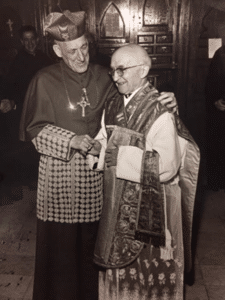
Months later, in January 1962, a worn and ailing Father Andolfi was admitted to Bon Secours Hospital in Methuen much to the concern of his loyal parishioners. Having received the sacraments of the Church, he passed into a week-long coma and died peacefully on February 5, as one of the friars was praying the rosary at his bedside.
The body of Father Andolfi lay in state in Holy Rosary Church from noon until 9PM on Tuesday and Wednesday, February 6 and 7, as several thousand parishioners, friends, admirers and officials came to pay their respects to a faithful and diligent, humble and unassuming servant of God. The Solemn Funeral Mass was celebrated by the prior of Holy Rosary, Father John A.M. Walsh, O.S.A. on February 8, 1962 with Gov. John Volpe in attendance and Auxiliary Bishop Jeremiah Minihane of Boston preaching the eulogy. Burial took place in the Augustinian plot of St. Mary Cemetery, Lawrence. Father Anthony Cirami, O.S.A., commissary provincial of the Italian vice province, conducted the committal service together with Father Walsh.
Father Andolfi, immigrant, religious, and priest, lived almost half of his 74 years in his adopted land of America. He did so ministering to others like himself, whether as commissary on behalf of his friars or as pastor among his beloved people. That he had left family and homeland behind made him one with those he served. He knew the sacrifices they had made, the hopes and dreams that motivated and sustained them, for these were his own as well. “Father Andolfi’s monument to his greatness was built before he died: it lies in the strong faith of his people, in their devotion to God and country, and the contribution they are making and will make to the growth of Holy Mother Church and the welfare and prosperity of our beloved America.” [14]
Michael Di Gregorio, O.S.A.
July 20, 2024
[1] The detailed coverage of the suppression and response are ably covered in Richard Juliani’s detailed history, Priest, Parish, and People, Saving the Faith in Philadelphia’s “Little Italy,” University of Notre Dame Press, 2007.
[2] The acceptance of this parish by the vice-province never materialized.
[3] VPA 252.04-03
[4] VPA
[5] The earliest request came in a letter of September 9, 1931
[6] The first was Father Walter Gough who served for two months and the second, Father Thomas Roland who did so for four months. Both resigned.
[7] VPA 204.11-17
[8] Evidently, one of the conditions was that Father Andolfi would not report until Father Milanese had left Lawrence which, in fact did not happen. VPA 202.11-05
[9] VPA 605.05-13
[10] VPA 252.04-7
[11] VPA Letter of February 19, 1941
[12] VPA 204.13
[13] 605.05. Folder 07
[14] Bishop Minihane’s words at the Funeral Mass
