
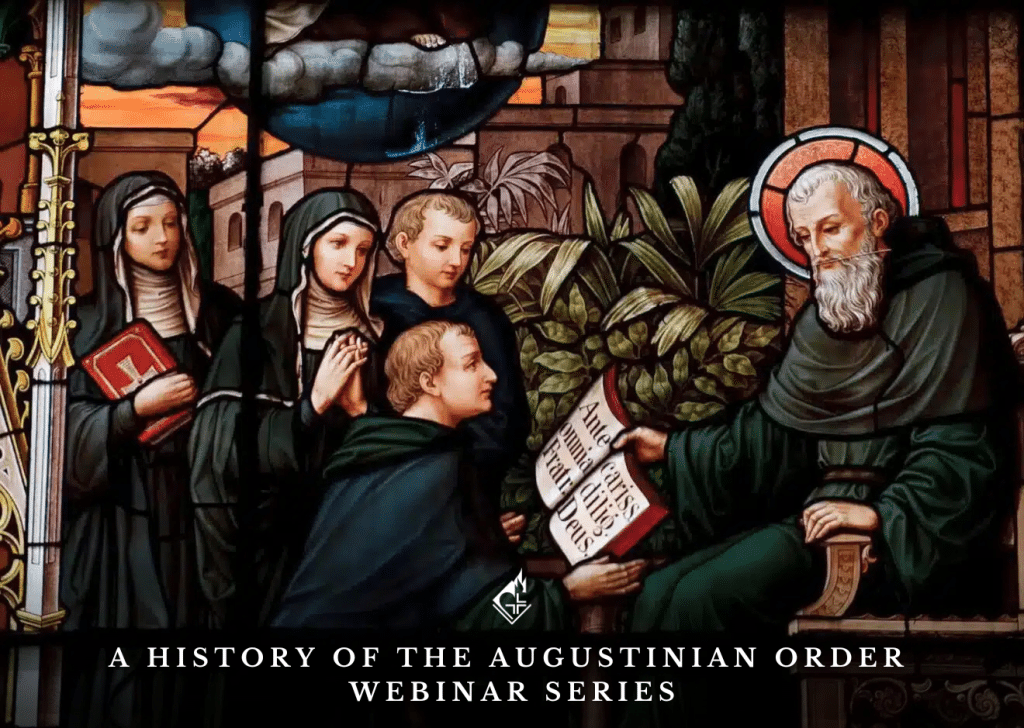
Please join the Lay Augustinians on Wednesday, April 8 at 7:00 PM for the third part of a four-part series about the history of the Order of St. Augustine and the development of Augustinianism from the death of St. Augustine in the fifth century to approximately the close of the fifteenth century, when the Order reached the height of its theological, intellectual, and cultural influence. Rather than treating the Order as a static institution, the series emphasizes a continuous historical narrative, tracing how Augustinian ideals were received, adapted, and institutionalized across changing social, political, and ecclesial contexts. Particular attention will be given to the antecedents inherited from late antiquity, the gradual formation of Augustinian life as a mendicant order, the conditions that allowed Augustinianism to flourish, and a series of sentinel events and foundational documents that have come to serve as touchstones for the Order’s identity.
The material is divided into four primary sections, each corresponding to a distinct phase in the historical development of the Western Church and its evolving reception of Augustinian thought. Taken together, these sections aim to demonstrate both continuity and transformation within the Augustinian tradition across a millennium of Christian history.
The Zoom link will be the same each month, so once you register you do not need to register again. New registrants will receive the Zoom to the event in their confirmation email. Make sure our emails aren’t being caught by your spam filter!
Meet the Moderator: D. P. Curtin
Dr. D.P. Curtin is an Irish-American psychologist, translator, and theologian. He holds degrees from Villanova University, Chestnut Hill College, and Chatham University. His work has appeared in First Things, Real Clear Religion, the Irish Catholic, Public Orthodoxy, Where Peter Is, and Catholic Exchange. He is also Editor-in-Chief of the Scriptorium Project.
April’s Topic: The Foundation of the Order
This section addresses the decisive shift toward mendicant life in medieval Europe and situates the Augustinian Order within this broader movement. The emergence of mendicantism is contrasted with earlier monastic forms, highlighting the new pastoral, urban, and apostolic emphases that defined the thirteenth century. Comparisons will be drawn between the Augustinians and contemporary mendicant orders, particularly the Franciscans and Dominicans.
Attention will also be given to earlier hermitical and semi-eremitical groups, such as: the Bonites, Williamites, and Brittinians, including their founders, and the distinct spiritual charisms they embodied. These disparate movements ultimately converged through a series of papal interventions, leading to the formal establishment of the Augustinian Order. The section culminates in an analysis of the key papal documents that unified these groups, notably Incumbit Nobis (the “Little Union”) and, a decade later, the “Grand Union” under Cum Quaedam Salubria, which definitively constituted the Order as a single mendicant body.