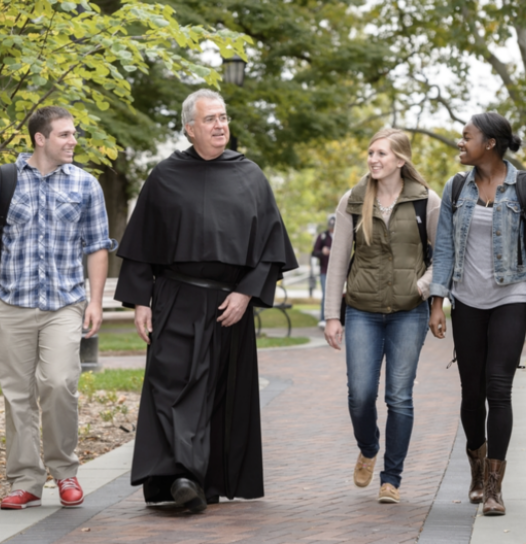
Here you will find a curated collection of background materials, historical context, and key resources to support accurate and inspiring coverage of the Augustinians. From our origins and spiritual charism to the work of our Province, leadership, vocations, and lay communities, this press kit offers an accessible overview of who we are and the mission that continues to guide us today.
About the Augustinians
The Augustinian Order, formally known as the Order of St. Augustine (O.S.A.), is a Roman Catholic religious order founded in the 13th century. It traces its spiritual roots to the teachings and Rule of St. Augustine of Hippo, particularly his emphasis on community life, prayer, and the pursuit of truth through love. The Order was officially established in 1244 when various groups of hermits in Italy were united under a common rule by Pope Innocent IV.
Augustinians live in community, sharing possessions and dedicating their lives to pastoral work, education, missionary activity, and scholarship. Their core values include community, truth, unity, and charity. The Order has made significant contributions to theology, philosophy, and education throughout history, and it continues its mission worldwide today.
About the Augustinian Charism
The foundation and characteristic of Augustinian life is life in common, in which friars seek to construct a path that is directed to God in service to others. We do this not only through the sharing of ideals and values, but also in the communion of all our material and spiritual goods. In this way we strive to grow through the gift of God’s grace, and so give witness to the mystery of the Trinity and of the Church, anticipating now on earth the reality we hope for in the future in the Father’s house.
The opening words of St. Augustine’s Rule give us direction: we are to be of one mind and heart on the way to God. We are travelers on pilgrimage together, wherein Christ is our constant companion, as well as our way and our goal.
The activity of our journey is shaped by Augustine’s own experience and counsel, and is characterized by three essential elements: the constant search for God by means of a deep interior life; the practical love of neighbor; and the constant pursuit of truth.
Adapted from the Order’s Constitutions and Plan of Formation
About the Augustinian Province of St. Thomas of Villanova
 The Augustinian Province of St. Thomas of Villanova, founded in 1796 by Irish friars Fr. Matthew Carr, O.S.A., and Fr. John Rosseter, O.S.A., is the East Coast branch of the Order of St. Augustine in the United States. Initially, the friars assisted bishops across wide territories, which made community life difficult and slowed the Order’s development.
Their first permanent foundation was the Church of St. Augustine in Philadelphia, Pennsylvania completed in 1801. In 1844, anti-Catholic riots led to the church’s destruction, though it was rebuilt and remains an active parish today. Around the same period, the friars acquired land outside the city and established Villanova College (now Villanova University), which became a major center for their educational and pastoral mission. In 1874, the Province was placed under the patronage of St. Thomas of Villanova.
Quick Facts About the Province:
- Number of friars: over 100
- Number of parishes: nine in the United States, four in Japan
- Number of institutions of higher learning: two (Villanova University in Villanova, Pa., and Merrimack College in North Andover, Mass.)
- Number of secondary preparatory schools: two (Malvern Preparatory School in Malvern, Pa., and St. Augustine Preparatory School in Richland, N.J.)
About St. Augustine of Hippo
St. Augustine of Hippo (354–430 AD) was an early Christian theologian and philosopher whose writings profoundly shaped Western Christianity and philosophy. Born in Thagaste (modern-day Algeria), Augustine was raised by a devout Christian mother, St. Monica, and a pagan father. In his youth, he lived a hedonistic lifestyle and explored various philosophies, including Manichaeism.
He eventually moved to Milan, where he came under the influence of St. Ambrose and experienced a dramatic conversion to Christianity in 386 AD. Augustine was baptized the following year and returned to North Africa, where he was ordained a priest and later became the Bishop of Hippo.
His most influential works include Confessions, an autobiographical account of his spiritual journey, and The City of God, a monumental defense of Christianity against pagan critics following the sack of Rome. Augustine’s theological insights, especially on grace, original sin, and the nature of the Church, became foundational for both Catholic and Protestant thought. He died in 430 during the Vandal siege of Hippo.
About Prior Provincial Fr. Robert P. Hagan, O.S.A.
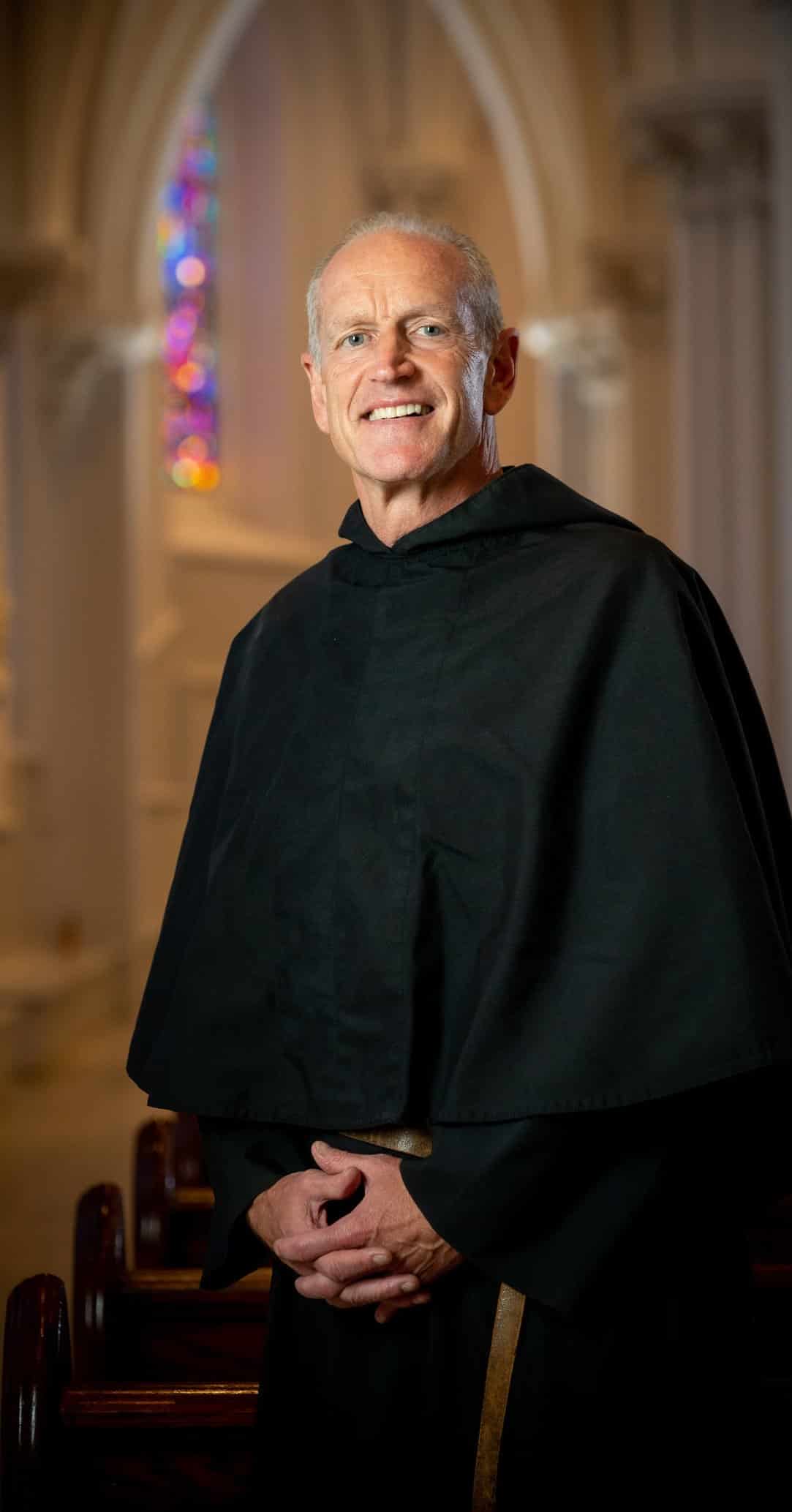 Rev. Robert P. Hagan, O.S.A., currently serves as the 41st Prior Provincial at the Augustinian Province of St. Thomas of Villanova. A native of Drexel Hill, Pa., Fr. Rob attended Cardinal O’Hara High School before going to Villanova University.
After graduating from Villanova in 1987 with a Bachelor of Arts degree, Fr. Rob went on to earn a J.D. from Widener University School of Law in 1990. He then spent seven years as an attorney with Gillin and Associates, where from 1990-97 he served as Criminal Defense Counsel in addition to handling contract negotiations, arbitrations and mediations.
He also served as counsel to the Delaware County Solid Waste Authority and the Delaware County Register of Wills. Fr. Rob is a past member of the Philadelphia Bar Association, the Delaware County Bar Association and the Delaware County Association of Criminal Defense Lawyers.
Fr. Rob was ordained to the Augustinian priesthood in 2003 at which time he joined Villanova University as the Assistant Athletics Director for Compliance and was eventually promoted to Senior Associate Athletic Director. In this role he oversaw all aspects of Student-Athlete Welfare, which included oversight of the Sports Medicine and Strength & Conditioning departments.
While at Villanova, Fr. Rob also served as the team chaplain for the football and men’s basketball programs. Along with his accomplishments in the athletics sector, he served as a prison chaplain at The Chester State Correctional Institution. Additionally, Fr. Rob currently serves as weekend assistant at St. Paul’s Parish in South Philadelphia.
About Augustinian Vocations
The invitation to men to consider the Augustinian way of life is a priority for the Province so that the distinctive gift of Augustinian spirituality might continue to exist and serve the Church in the years ahead. The invitation is a call to those who share a passion for Christ and the Gospel, and who experience the desire to live with like-minded men in spiritual communion and in service to God’s people.
Augustinian formation unfolds in community but begins with honest self-awareness and the companionship of experienced friars who are available for this task. A regimen of prayer, community living, service, and study become for the candidate a full-time occupation. Those who are called to serve and enter religious life commit to an intense journey of academic and spiritual formation that focuses on the development of a mind and heart prepared both for life with others and generous service.
The Process of Formation
- Discernment
- Associate Program
- Pre-Novitiate
- Novitiate
- First Vows
- Pastoral Year
- Solemn Vows
For those going onto Holy Orders:
- Ordination to the Diaconate
- Ordination to the Priesthood
Contact:
Fr. Jeremy Hiers, O.S.A., Director of Vocations
(445) 206-0825
jeremy.hiers@augustinian.org
https://www.beafriar.org/
About the Lay Augustinians
 Lay Augustinians are one of the three branches of the Order of St. Augustine. The whole Augustinian family is made up of Augustinian Friars (the first order), Augustinian Nuns (the second order), and members of the laity who are inspired to live their lives in accordance with the Rule of St. Augustine (the third order).
The Lay Augustinians are committed to live a life in relationship with Jesus by virtue of their Baptism in the spirit of St. Augustine. They experience his spirit when they come together as a community to pray and to study his writings.
St. Augustine continues to serve the church through the influence of his writings. The Lay Augustinians also continue to serve the church in particular ministries which involve the secular life which embraces marriage, family, work, political and economic activity, culture, scientific research, education, etc.
Contact:
Jim Burke, Director, Lay Augustinians
610.527.3330
james.burke@augustinian.org
https://www.layaugustinians.com/
For additional information, contact:
Madonna Sutter, Director of Advancement & Communications
67.272.3048
madonna.sutter@augustinian.org