The difficult decision taken by the province to withdraw from the parishes of Saint Mary in Waterford and Saint Augustine in Troy, New York, has brought to an end a very long and fruitful chapter in the history of Augustinian presence in the Diocese of Albany where our friars ministered faithfully for over 160 years. Among the significant fruits of their labor was the number of vocations that were added to the Order and the Church over the course of those sixteen decades. Unique among these are three from Troy whose lives are intricately tied together as one story.
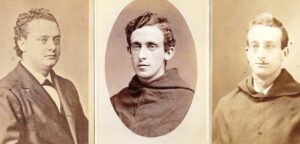
Charles, John and William Marsden, the three sons of Laurence Marsden and Helen Duckett, were born in Clitheroe, England, and emigrated to the United States with their mother and sister in 1858, making their home in Lansingburgh, as Troy was known then. Their father, a convert from Protestantism, who had arrived some time earlier to prepare the way for his family eventually became organist at Saint Augustine Church as did the family’s only daughter, Mary. In fact, all of the children were musically gifted, and the three brothers would later make use of this talent in the exercise of their ministry.
The year of the Marsdens’ arrival in America coincided with the beginning of Augustinian responsibility for Saint John the Baptist Parish in Lansingburgh. Father Thomas Galberry, O.S.A. assumed the pastorate in January 1860, succeeding Augustinian Father Mark Crane. It was Father Galberry who replaced the original wooden building with a new church and offered the first Mass within it, now renamed in honor of Saint Augustine, on Christmas Eve, 1865.
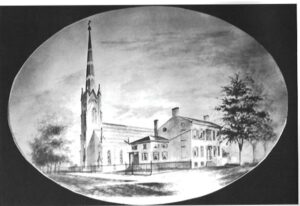
Father Galberry came to know the Marsdens well during his ten-year pastorate and served for a time as tutor to the two older brothers. Some years later, first as Commissary General, and then as first elected prior provincial, he welcomed each of the Marsden brothers into the Order, received their profession of vows, rejoiced in their ordination as priests, and sadly, pronounced the final absolution at the funeral of Charles, who died just shy of his 32nd birthday in 1877. Unfortunately, Father Charles’ premature death was not exceptional. Both of his brothers would die before they reached the age of 30.
Charles Marsden, the eldest of the three, was born on September 29, 1845. He attended the Latin School at Troy under the Christian Brothers and enrolled at Villanova College in 1865, the very year that the school re-opened after more than seven years of suspended activity. On January 5, 1866, Charles entered the Augustinian novitiate and made his simple profession of vows with three companions one year later. He then continued his academic studies at the college while also serving as a member of the faculty, teaching Arithmetic, English, Geography and Christian Doctrine. On January 30, 1870 he and his three novitiate classmates were ordained priests at Saint Augustine Church in Philadelphia. At the time, John Marsden was just beginning his novitiate year at Villanova while William was still attending school in Troy.
Some months following ordination, Father Charles became a naturalized citizen of the United States, and continued on as a professor at Villanova, teaching rhetoric at the college, and serving as the first president of the Dramatic Society. As his gifts as preacher and public speaker became widely known, he was invited to lecture at civic gatherings in the surrounding area and to preach in various parishes of the diocese. His discourse on Saint Patrick brought him invitations in 1874 to local churches, and the following year to Newburyport and to Saint Mary’s in Lawrence, Massachusetts. Charles also authored a series in the Catholic Standard weekly of Philadelphia – Ben Sterne a story of modern times, – which ran in 1874. An especially happy occasion came the following year, when the three Marsden brothers gathered at St. Augustine Church in Philadelphia for the first mass of the middle brother, John, on the 14th of March. Charles assisted as deacon of the mass while William was sub-deacon.
John Marsden was born on September 23, 1851 and was baptized there in the local Catholic Church in Clitheroe five days later. Following the completion of studies at the Latin School in Troy, he enrolled at Villanova in 1869 and began his novitiate on January 23, 1870 with four classmates, all of whom made their first profession in the Order on January 21, 1871. John was solemnly professed on January 25, 1874 and continued his studies at Villanova.
Father John’s first assignment as a priest was to St. Mary’s in Lawrence. In April 1875, he was appointed director of the choir and his proficiency as pianist, organist and director benefited various fundraising events. At the Centennial celebrations held at Saint Mary’s in which he directed the combined choirs of the city’s Catholic churches, $2,000.00 was brought in for the assistance of the poor, no meager sum at that time.
In the summer of 1875 Father Charles Marsden was also assigned to St. Mary’s. One of his specific duties was to take charge of the parish’s outreach in the city of Methuen. Thus, two of the brothers were together again for the period of a few years, while by this time, their youngest brother, William, had also entered the Order, made his novitiate, and was a professed student studying at Villanova.
 March 19, 1876 was a day of great jubilation for the Augustinians as Father Thomas Galberry was consecrated fourth bishop of Hartford, Connecticut. Both Father Charles and Father John were among the Augustinians who traveled to St. Peter’s Church in Hartford, to participate in the ceremony, no doubt filled with joy and pride as their former teacher, pastor, superior, and friend was called to serve the Church as one of her Chief Shepherds!
Christmas day, 1876, saw another joyous and somewhat unique event in the city of Lawrence as all three Marsden brothers celebrated a Solemn Mass with John as celebrant, Charles as deacon, and William as sub-deacon.
William Marsden was a month passed his 19th birthday when he entered the novitiate at Villanova in 1873. His arrival brought the three brothers together on campus for the following two years where John, a friar in simple vows, was completing his studies, and Charles was a member of the college faculty.
On January 25, 1874, William pronounced his simple vows and in that same ceremony, John made his solemn profession. Studies continued on at the college into the Spring of 1877, with William professing solemn vows on Friday, January 26th of that same year. Ordination to the priesthood for him and Fathers Francis McGowan and Francis Rowan followed months later on July 14, 1874 in the gymnasium chapel at Villanova, officiated by Bishop Jeremiah Shanahan of Harrisburg, PA. Though the record does not say so, we can only imagine that Charles and John, and perhaps even their mother Ellen and sister Mary, were also on hand that day to share William’s joy and to participate in his first mass. [1] If so, it may have well been the last time that the three brothers would have stood at the altar together, for within less than two months time, Father Charles’ journey had come to an end.
An Unexpected Sadness
Joy and sorrow weave through the story of every life and every family to be sure, but for the Marsden brothers they would seem to follow one another with uncommon speed. As was true in the case of his classmate, Timothy Donovan, so too, the death of Father Charles struck without warning. His illness was very brief. On Friday noon, September 21, 1877, he suddenly experienced great intestinal pain. A doctor was called but he did not consider the case serious. When he left him, in fact, Father Charles was feeling rather comfortable. The following day, however, the illness gradually worsened and, in the evening, attending physicians who had been summoned decided that the case was hopeless. The pastor, Father John Gilmore, who was a contemporary of Charles – just a year older – had the unhappy task of communicating the doctors’ prognosis. “Father Marsden, apparently perfectly resigned, desired that the last rites of the Church be administered to him … and at 5:30 o’clock on Sunday morning, while in full possession of his senses, his soul quietly and gently took its departure from earthly scenes and labors, to dwell in the heavenly realms.” [2] Six days later, he would have celebrated his 32nd birthday.
Father Charles was remembered as a friar who was “universally endeared to all who knew him … in his manner he was gentle and prepossessing, lively and vivacious, courteous and genial. As a companion he was social and entertaining; and never wary in dispensing charity.” [3] The September 29th issue of the town newspaper reported a detail that would strike many Catholics today as quite curious, namely that “in consequence of his death no sermons were preached, or music rendered in any of the Catholic churches on Sunday.” [4]
The funeral was held at 10:30 A.M. on Wednesday, September 26, 1877, at St. Mary’s. The spacious church was filled to capacity with hundreds more waiting outside. Seventy members of the clergy are recorded as taking part, including Bishop Galberry of Hartford. A diocesan priest, Father Delahunty of Boston Highlands, was chosen as celebrant, with Augustinians Father Michael O’Farrell, Charles’ classmate, of Villanova College, as deacon, and Father Peter McGovern of Lawrence as sub-deacon. Father Michael Collins, at the time rector of Charles’ home parish of St. Augustine in Lansingburgh, was master of ceremonies. Following the mass, as was the custom of the time, the funeral oration was preached by Father Richard J. Barry of West Roxbury, Massachusetts, also a diocesan priest. In the course of his sermon, he gave the following portrait of the deceased,
“He was … a laborious student, a ripe and finished scholar, a faithful and devoted teacher… After he became known to the clergy of this diocese, he was frequently invited to preach in other parishes. He passed from pulpit to pulpit, until he preached in nearly every church in the diocese of Boston…. All who knew him will bear witness to the single heartedness and disinterestedness of his zeal; all will testify to the willingness and readiness with which he performed a good work. He was indeed a faithful servant of God; a true priest of Jesus Christ; a devoted follower of his chief, the great St. Augustine. In him all the elements of genuine consecration and true Christian humility were found… Love of neighbor was his darling virtue. His was a truly Gospel love, that knew neither race, nor creed, nor country. His was a forgiving spirit… To sum up in one word, no more genial, tender-hearted, noble-minded priest ever lived than Father Charles Marsden…”[5]
With John and William Marsden and the great gathering of Augustinians, priests, and faithful – including, presumably Charles’ mother and sister – looking on, Bishop Galberry gave the final absolution over the young friar whom he had known first as a young boy, and in whose journey to religious life and the priesthood he himself had played no small part. No one could know at the time that just one year later friars of the province, including John and William, would gather for the funeral of the very next of their confreres to die, Bishop Galberry himself. As the funeral procession now moved from the church to the street outside, the bells of St. Mary’s and Immaculate Conception’s Churches tolled. Father Charles was buried alongside his confreres in St. Mary’s Cemetery, including his friend and classmate, Timothy Donovan.
Laboring in the Vineyard
Following ordination, Father William remained at Villanova where, as a member of the house chapter, his signature appears on a letter of July 12, 1878 attesting to the election of that community’s discreet or representative to the upcoming Provincial Chapter. At that Chapter, celebrated a few days later, he was re-appointed a member of that same community whether as a teacher at the college or assisting at the campus church and the other parishes which the friars cared for in the area. Certainly, for a time he was assigned to Our Mother of Consolation in Chestnut Hill.
On October 10, 1878, the sad news circulated quickly among the Augustinians that Bishop Thomas Galberry had died in New York as he was travelling to Villanova from Connecticut for a few days rest. When he had begun hemorrhaging during the journey he was taken from the train to a hotel where he lingered for some hours but finally succumbed. Father William went from Villanova and Father John from Lawrence to participate in the funeral mass on October 15th in the as yet uncompleted cathedral whose construction the bishop himself had been overseeing. It was only two and a half years since the day that John had participated with his brother Charles in the joyous occasion of the bishop’s consecration.
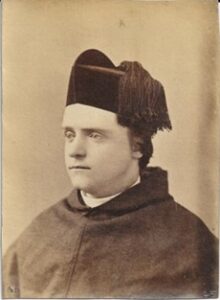
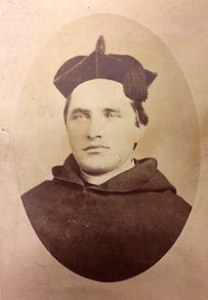
During this year 1878, from July through December, John took on additional duties at Saint Mary’s in Lawrence while the pastor, Father Gilmore was away in Europe. The Provincial Chapter which was held that summer appointed him procurator of the community as well. Whether, or to what extent, these duties placed undue stress on him is not clear, but by the month of August John began to show signs of failing health with the hemorrhaging of blood, the tell-tale sign of consumption, the same condition to which Charles had succumbed. With the return of Father Gilmore to Saint Mary’s, John left in January 1879, for Jacksonville, Florida, on the advice of his physician and the subsequent instruction of his superiors, to rest and regain his strength in a much warmer climate for the duration of the winter months. In May he went to Philadelphia, seemingly improved, and in July returned to Lawrence, where he was in good spirits and apparently in better health. By September, however, he began to hemorrhage again quite seriously, and doctors could find no remedy to assist him.
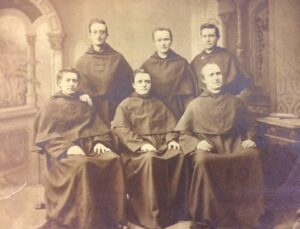
Seated: Fathers Peter McGovern, John Gilmore and Ambrose Mullen
In a strange coincidence of events, it was Father Gilmore who reported the doctors’ prognosis to young Father John just as he had done only two years earlier to Father Charles. Resigned, as his brother had been, he asked to receive the sacraments, which the pastor administered to him at 8:00 on Sunday evening, September 28th. In subsequent days he seemed to improve but then again worsened such that on Wednesday evening it was obvious that the end was near. During most of the night he was alert and at prayer, but from time to time his mind seemed to wander such that he spoke as though he, as priest, were attending some other person in his or her final moments. Death finally came at 8 AM on Thursday morning, October 2, 1879. He was 28 years old.
The Solemn Requiem Mass was celebrated at Saint Mary’s on Tuesday, October 7 at 10 AM. Father Pacifico Neno, Prior Provincial, led the approximately 50 Augustinians, visiting clergy and overflowing congregation in the recitation of the Office of the Dead and in the Mass. At the end of the Mass, Father Henry Fleming O.S.A., of Saint Augustine Church, Philadelphia, a novitiate classmate who had spent several weeks with Father John during his illness, gave the sermon. [6]
“Were the time and ability mine to speak of him as my heart would wish and your hearts would be consoled to listen, I could not say too much of this dear priest; of his purity, his docility, his zeal, his charity, and his devotion and love for the people amongst whom he had his first mission… Just as you knew him since he came to you in the first days of his priesthood, just as I knew him for eleven years, has he ever been, gentle, pious, single-hearted and devoted to duty. Pure and virtuous as a priest, he was pure and virtuous as a boy, as a child, and what he was as a child he continued through the 28 useful years of life that were vouchsafed to him. He was so young and the life before him was so bright and full of golden promises… his career was short, and the simplest and truest praise we can give it is that it was all that it ought to have been as the career of a good and holy priest, and a devoted and zealous son of St. Augustine; pious, earnest and unselfish to a remarkable degree.” [7]
Father Neno performed the final absolution, and the coffin was borne by four of the friars to the hearse and brought to St. Mary’s Cemetery for burial. A sorrowing mother buried her second son.
Parishioner Katharine O’Keefe remarked in her tribute to Father John, “the four years and more of earnest labor that he spent among the Catholics of Lawrence, earned their appreciation and gratitude; while his gentle and amiable disposition won for him not only their affection, but also the respect and regard of the people of other denominations who had his acquaintance.” [8]
Return to the North
On June 8, 1881, Father William was sent to Mechanicville, New York. This was a temporary assignment to replace Charles’ former novice master, Father Filippo Izzo, O.S.A., who, after two years at Villanova had moved to upstate New York to work among the Italian immigrants, and who was now about to return to his native Italy. A month later, on July 5th, William received a permanent transfer from Chestnut Hill to the Parish of St. Patrick in nearby Cambridge, where he would serve as vicar prior and rector, succeeding Father George A. Meagher, O.S.A. The Provincial Chapter of July 1882, of which William was a member, confirmed the 28-year-old friar in the office of pastor and appointed him prior of the community there as well. His work there would not continue much longer, however, for he died in the friary on February 17, 1883 at the age of 29. His funeral Mass was celebrated at Cambridge, after which his body was taken to Lawrence, Massachusetts, to be interred in Saint Mary’s Cemetery near to those of his two brothers.
William’s successor as pastor at St. Patrick’s was Father Francis McCranor, O.S.A., the brother of his classmate, Father Arthur McCranor, O.S.A. One of Father Francis’ tasks at the parish was the enlargement and renovation of the church. On Sunday, June 14, 1885 the church was rededicated with several new windows put in place, one of which – that commemorating Saint Augustine – was dedicated to the memory of Father William Marsden.
The lives of Fathers Charles, John and William Marsden are three among the very many that tell the story of the Augustinians in the United States from the first day of the Order’s American venture until the present moment. Their participation in the life of the Province, though brief, and their contributions, though understandably limited, have nonetheless helped to shape the identity and legacy of Augustinian presence in North America over the course of more than two centuries.
Michael Di Gregorio, O.S.A.
Villanova, PA
[1] Laurence Marsden, the father of the family, had passed away on November 7, 1867 at the age of 43, after a long and painful illness, according to the Lansingburgh Gazette of that same date.
[2] Lawrence Sentinel, September 29, 1877 in Sketch of Catholicity in Lawrence, Katharine O’Keeffe 1882, p. 166.
[3] Ibid. p. 167
[4] Ibid. p. 167
[5] Sermon in Sketch of Catholicity in Lawrence, Katharine O’Keeffe 1882, pp 167-171
[6] Though he preached without a text, parts of his talk were recorded by Miss Katharine O’Keefe, and published in her aforementioned book.
[7] Sketch of Catholicity in Lawrence, Katharine O’Keeffe pp 258-262
[8] Sketch of Catholicity in Lawrence, Katharine O’Keeffe p 258
