By Fr. John Lydon, O.S.A.
The Augustinian formation house in Trujillo, Peru, named after St. Thomas of Villanova, marked its 35th anniversary during the Augustinian Vicariate’s annual assembly. The house’s construction and opening were supervised by the present Pope Leo, so this anniversary provided an opportunity to share memories about living with him as the formation director during his twelve years in Trujillo. Many of the stories and insights that were shared help to understand the priorities the pope has set in his first months as the successor of St. Peter. Prior Provincial Fr. Tony Pizzo, O.S.A. from the Midwest Province and Fr. Art Purcaro, O.S.A. and Fr. John Lydon, O.S.A. from the Villanova province were in attendance, as well as two Augustinian bishops that were formed in the Trujillo community and the two bishops from Trujillo.
The event began in the afternoon of Thursday, January 8, with a video showing the construction process of the house and the first couple of years of its existence. The video used photos that were recently found in boxes, once the search for things of Pope Leo’s time became a priority. After the video there was the traditional Peruvian brindis, or toast, offered by the Superior of the Augustinians in Peru, the Vicar Ramiro Castillo.
Following the toast, there was a sharing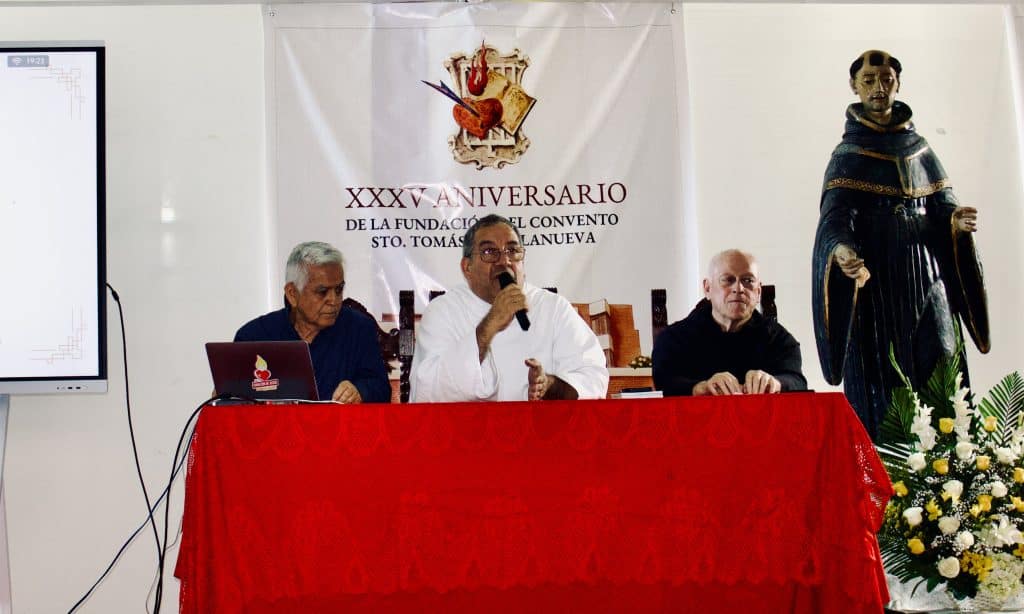 by three people about their memories of Pope Leo. The first was a layman, Magno Ruiz, who was in the first delegation of neighbors to come to the new Augustinian community to request sacramental attention in the residential zone surrounding the house. He told the story of the very willing Padre Roberto to help with the request of and the process through the municipal government of getting some donated land to build a chapel, which years later would become St. Rita’s Parish.
The second sharing of stories was by Fr. Gioberty Calle, O.S.A., one of the first Augustinians who entered the formation house with Fr. Prevost as the formation director. Fr. Gioberty told of the great pastoral zeal of the present pope and his outreach to the more isolated and poorer zones under our pastoral care. He also underscored the fraternal nature he showed as formation director, something that was not so common in most Peruvian formation settings.
The third intervention was by Fr. Art Purcaro, O.S.A., who served part-time in Trujillo giving classes in the seminary, but who knew the pope mostly from living with him as an assistant general in Rome from 2007 to 2013. He was able to share about the collegial nature of Fr. Bob’s leadership style as prior general, something that resonated with the experience of all those who passed through the Trujillo formation house.
After the three speakers shared their stories, a singing and folklore dancing group from the Catholic University of Trujilo put on a magnificent performance of Peruvian songs and dance.
 The following day, Friday January 9, began in the morning with the main talk of the anniversary event, presented by Fr. John Lydon, O.S.A. He was asked to talk about how the experience of working in Peru, especially Trujillo, would have influenced Pope Leo in forming his vision of Church. Fr. John lived with the present pope for 10 years in the Trujillo community and so was able to share based on a long relationship living and working with the Pope. He underscored four important influences:
- Both Pope Leo and Fr. John came to Peru as young priests and were really formed in how to be ministers by the Peruvian people. The welcoming spirit, the openness to collaborate in the pastoral work, the warm embrace of the missionaries, and the unique religious and cultural traditions of Peru all were evident and were the central influence in the pastoral formation of these young Augustinian Priests.
- The “preferential option for the poor” was a guiding principle of the Augustinians in our missions of Chulucanas, and likewise became central in the formation of future Peruvian Augustinians in Trujillo.
- The pastoral plan of New Image of the Parish, which was implemented in the late 1970s in the Augustinian missionary dioceses of Chulucanas, was also implanted in Trujillo. Bob felt that since we were preparing future Augustinians to return to our primary commitment in Chulucanas, that we would implement this plan in the two parishes that we were responsible for in Trujillo. This brought in a large number of lay people who directed almost all of the pastoral programs of the parishes through the creation of pastoral parish zones. Indeed, it meant that our parishes had the synodal structure decades before it became a word known in the United States.
- Team ministry. Both the formation work and the pastoral service to the people were based on a team ministry model. This is a reflection of the spirituality of the Order, but even more so by the personal conviction of Padre Roberto that this was the best model to ensure that things went along with mutual agreement and its subsequent lack of internal tensions.
All of these four points then found concrete expression in the formation of the community of Trujillo in the 1990s when Fr. Bob, Fr. John Lydon, O.S.A., and Fr. Rich Mullen, O.S.A., served there along with several other friars from different provinces of Mexico. There was a great fraternal spirit within the formation house, and also a model of integral formation which emphasized the centrality of community prayer, academic studies, the building of a solid internal community of friendship, and the outreach to the people of God in our ministries.
During the 1990s Peruvian society was passing through a dark phase of its history, with the presence of two terrorist movements and the installation of an authoritarian political regime that ended most vestiges of democratic rule. Our community could not remain on the sidelines of this social reality; thus the cause of human dignity became a constant guide in our formation process and pastoral outreach. Fr. Bob made sure that the outlying and poorest parts of the parish were visited regularly and that the sacraments were celebrated there, rather than have the poor walk to the main parish building. This the people appreciated very much since it was so unique in their experience of life, where the poor in Peru were marginalized and ignored. Also in defense of Catholic Social teaching regarding human rights, our formation community and parishioners participated in protest marches and, through cultural events, composed songs that underscored human dignity and democracy. In 1998, marking the fiftieth anniversary of the Universal Declaration of Human Rights, there was a national campaign of gathering signatures in support of human rights against the abuses perpetrated by the government. In fact, the two Augustinian parishes under Fr. Bob’s leadership gathered more signatures than any other institution in the country. All of these actions helped form our Peruvian Augustinians in the need to be close to the people, especially the victims of violence and poverty.
In conclusion, after explaining the history of the formation house and Fr. Bob’s presence there, Fr. John suggested that Pope Leo will continue with several things that marked his presence in Trujillo:
- He will be especially attentive to the cry of the poor and place that in the center of his teaching.
- The cause of human dignity that gives a prophetic church voice where abuses are committed will be an important part of his witness to the world.
- He will endeavor to build bridges of dialogue and promote reconciliation as a pathway to dialogue and respect among peoples of different cultures and mindsets.
- The promotion of team ministry based on the conviction that this best represents the model of Church needed for our present times.
Following the talk, the Augustinian Vicariate of Peru awarded Pope Leo medals to those whose special contributions help build the present-day Peruvian Vicariate. Three were for the prior provincials of the American provinces – Fr. Tony Pizzo, O.S.A., (Chicago), Fr. Rob Hagan, O.S.A. (Villanova), and Fr. Barnaby Johns, O.S.A. (California) – in recognition of the continual support of the American provinces in the Peruvian missions since the first ones arrived in 1964. (Fr. Tony Pizzo was the only one able to be present and he received them in the name of all the provincials).
Three other medals were given to the three Peruvian bishops that were students in this Trujillo formation house: Edinson Farfan, Wilder Vasquez, and Lizardo Estrada (who as Secretary-General of the Latin American Bishops Conference was in Rome and could not be present).
Finally, Bishop Dan Turley, O.S.A. (who was not able to be present), Fr. Art Purcaro, and Fr. John Lydon received medals for their contributions and in representation of the numerous Augustinian Friars who served in Peru during all the years and who help build the present Vicariate, which is composed of all Peruvian friars.

The ceremony ended with a special Mass presided by Bishop Edinson, who underscored his appreciation for the formation received in the Trujillo community which has marked his own pastoral ministry ever since.
Perhaps the most notable fruits of the formation house is the number of Peruvian friars working in Peru. The following day, one more was added with the ordination Mass of one of the newer members of the Vicariate: William Reyes, the first vocation from the very parish Fr. Bob – now Pope Leo – formed long ago in Trujillo.

